What if you could start a real business without renting an office, hiring a large team, buying expensive equipment, or investing a huge amount of money upfront?
That is no longer an unusual idea.
The internet has already made it possible for freelancers, creators, consultants, ecommerce sellers, and digital product creators to work from home. Now AI is changing the way these businesses operate.

In 2027, AI is no longer just a tool for writing blog posts or generating images. Businesses are using AI to assist with content creation, video editing, research, marketing, ecommerce tasks, customer communication, data analysis, and workflow automation.
For example, Upwork’s 2026 marketplace data reported that demand for skills explicitly involving AI grew 109% year over year. AI video generation and editing grew 329%, while AI integration grew 178%. At the same time, established skills such as graphic design, virtual assistance, and other professional services continue to have demand.
But there is an important point to understand before we go any further.
You cannot simply open ChatGPT, type a few prompts, and expect a business to generate money automatically.
The real opportunity is different.
You can use AI as an assistant to research faster, create more efficiently, handle repetitive work, test ideas, and free up more of your time for the things that actually require human judgment.
In this guide, we’ll look at 5 online businesses you can start without an office, how AI can fit into each one, what a realistic workflow looks like, how beginners can get started, and what you should watch out for.
If you’re searching for unique business ideas, AI business ideas, online business ideas from home, business ideas for beginners, business ideas 2026, or online business ideas with low investment, this guide is for you.
Can You Really Start a Business Without an Office?
Yes.
But let’s make one thing clear.
“No office” does not mean “zero cost.”
You may still need a laptop, internet connection, software, domain, hosting, advertising, marketplace fees, payment processing, or other tools depending on the business.
The advantage is that many online businesses don’t require you to rent a physical workspace before you have customers.
Think about the difference.
A traditional business might require:
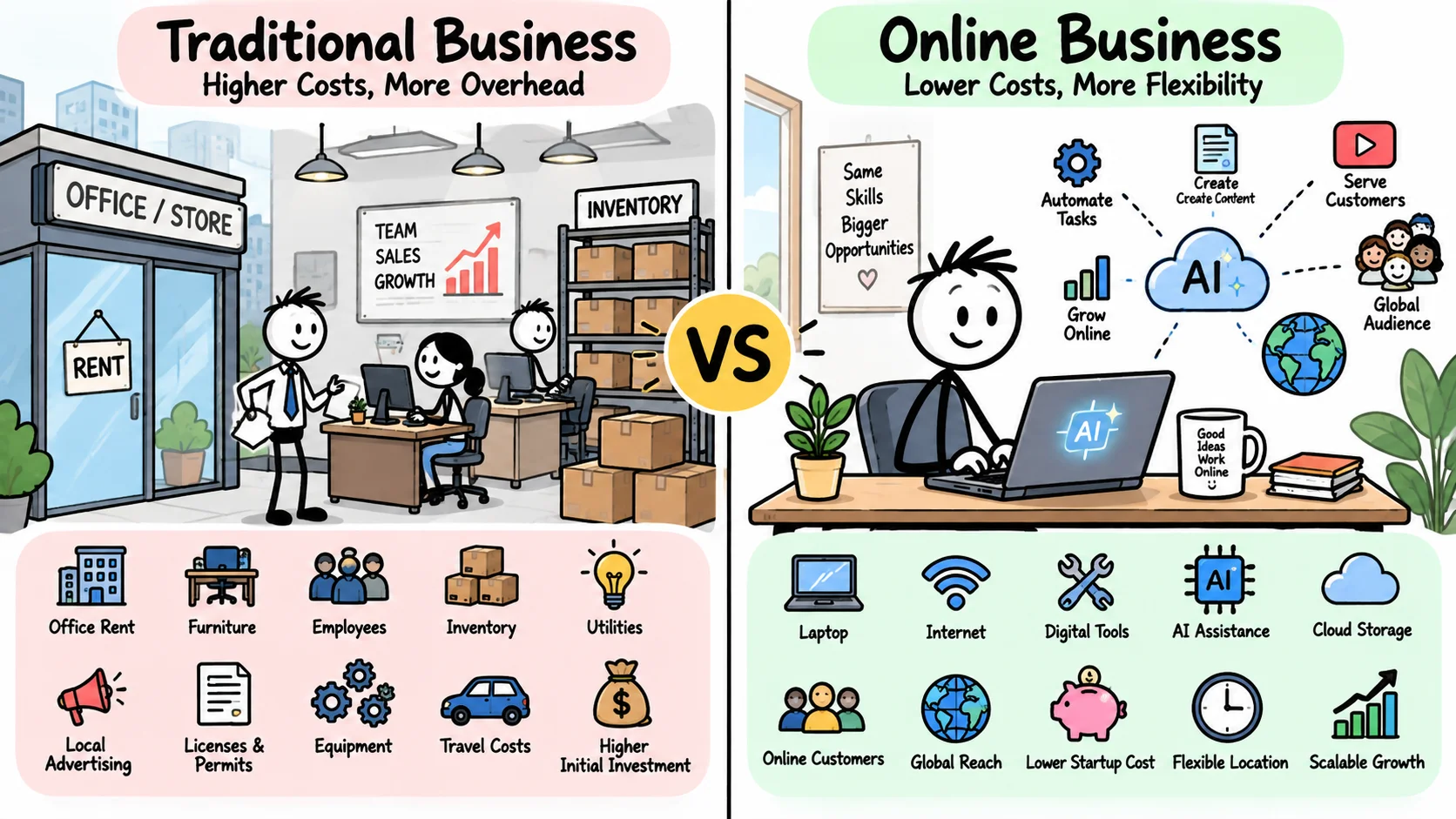
- Office or shop
- Furniture
- Utilities
- Inventory
- Employees
- Local advertising
- Physical equipment
An online service business might start with:
- Laptop
- Internet
- One useful skill
- A portfolio
- A way to communicate with customers
AI can then help you handle some repetitive work more efficiently.
For example, Shopify now provides AI-powered tools such as Shopify Magic and Sidekick to assist merchants with things like product descriptions, content creation, store analysis, and other ecommerce tasks. Shopify also warns that AI-generated information can contain errors and should be reviewed before publishing.
That is a good example of how AI should be used.
Not as a replacement for thinking.
As a tool that helps you work faster.
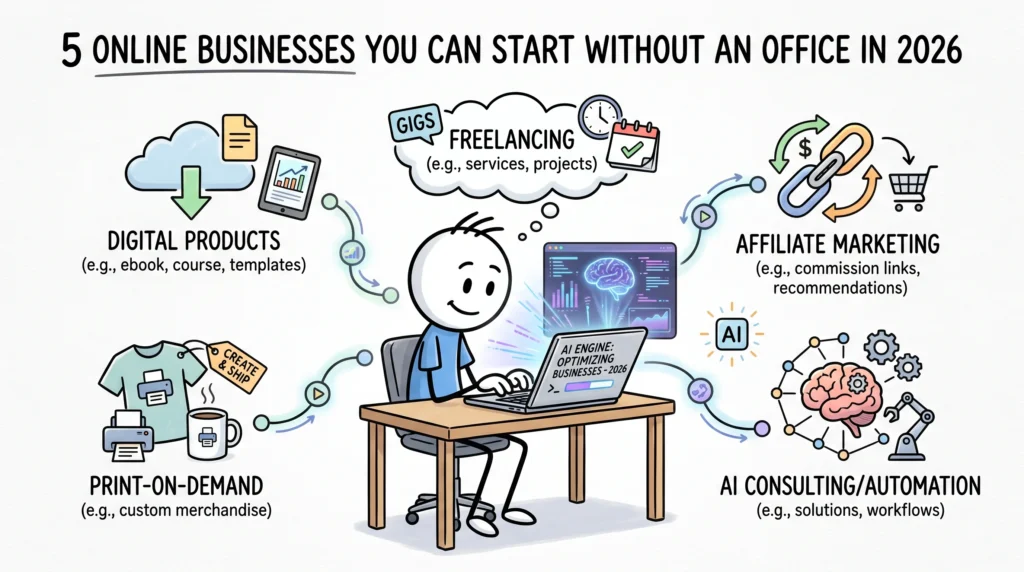
5 Online Businesses You Can Start Without an Office in 2026
1. AI-Powered Freelancing Business
Let’s start with one of the simplest online business models: freelancing.
If you already have a useful skill, freelancing can be one of the easiest ways to test an online business without renting an office.
You could offer:
- Graphic design
- Video editing
- Content writing
- SEO
- Web development
- Presentation design
- Social media management
- Thumbnail design
- Virtual assistance
- Research
- Data analysis
But there’s a major difference between traditional freelancing and the opportunity available today.
Instead of simply selling a skill, you can build an AI-assisted service around a specific customer problem.
For example, don’t just say:
“I’m a video editor.”
You could say:
“I help YouTube creators turn long-form videos into short-form content.”
That’s a much clearer offer.
How AI Can Help a Freelancer
Imagine you’re editing YouTube videos.
A traditional workflow might look like:
Raw footage → Manual editing → Captions → B-roll → Revisions → Final video
An AI-assisted workflow might look like:
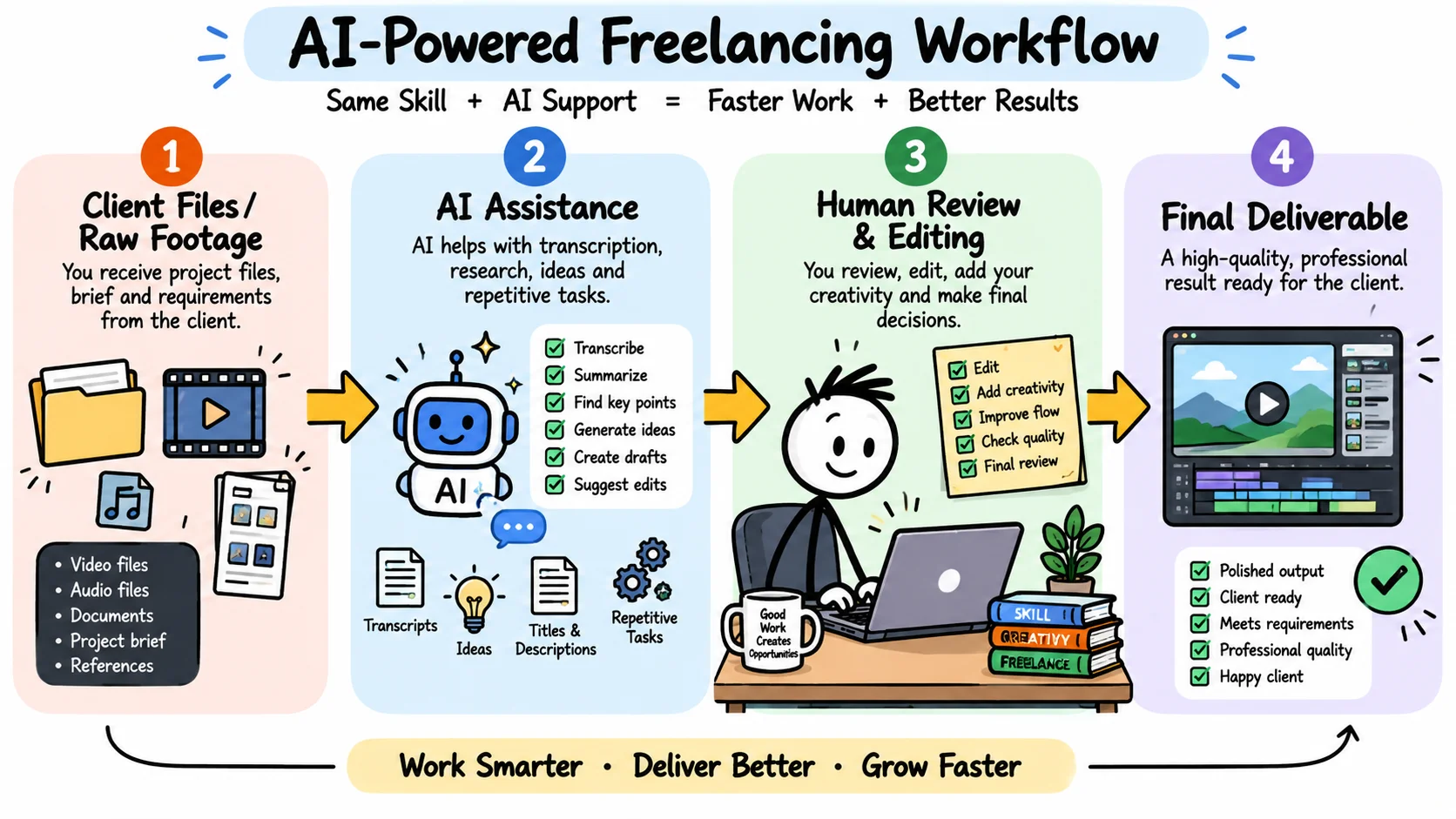
Raw footage → Transcription → Content analysis → Short-form ideas → Caption assistance → Human editing → Final video
AI can help with parts of the workflow such as:
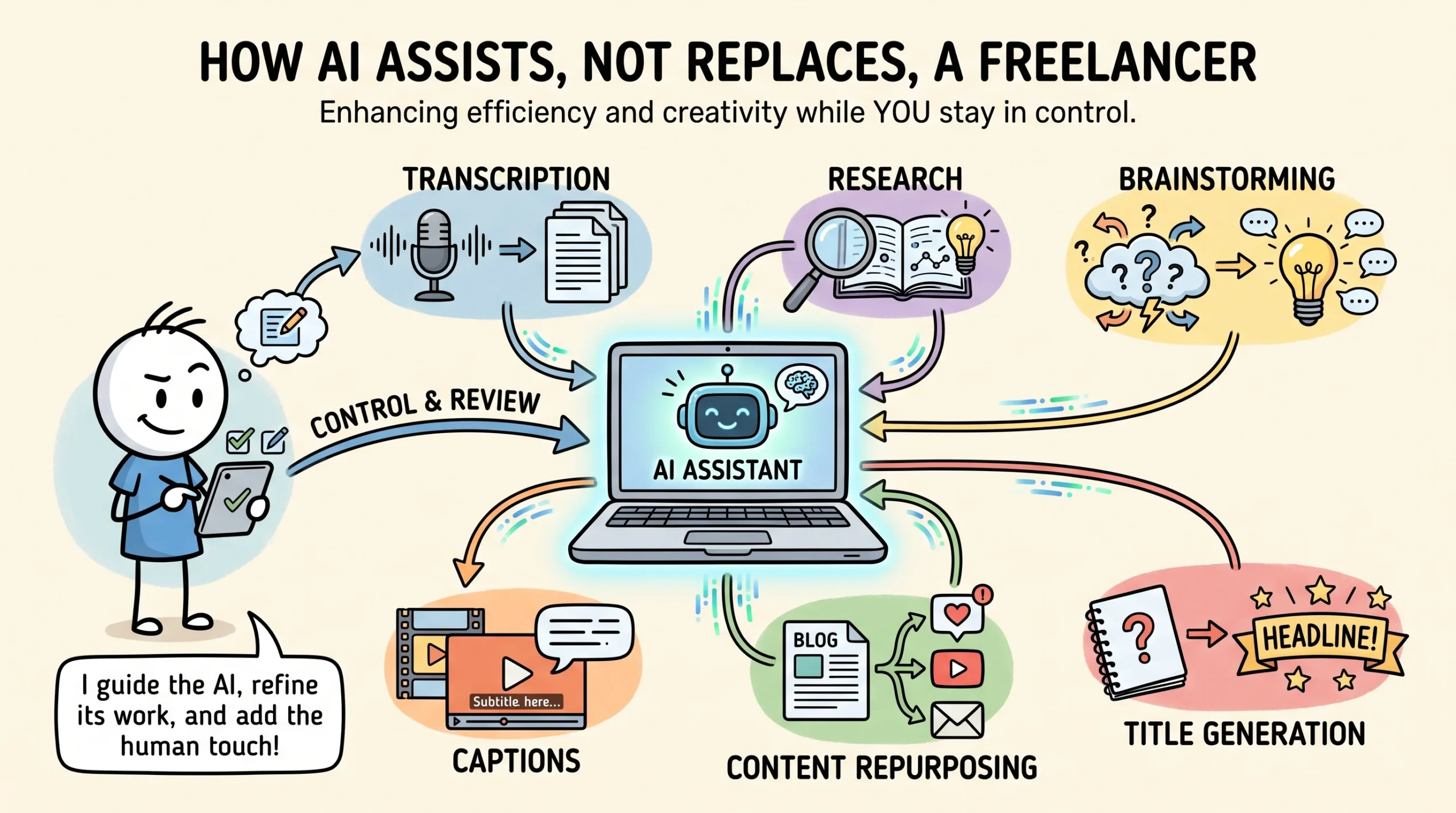
- Transcribing videos
- Finding potential highlights
- Generating hook ideas
- Creating caption drafts
- Brainstorming titles
- Creating descriptions
- Repurposing content
- Organizing research
- Creating first drafts
But you still need to make the final decisions.
That’s important.
Upwork’s 2026 research found strong growth in AI-related creative work, including AI video generation and editing. The platform also reports continued demand for traditional professional skills.
So you don’t necessarily need to abandon your existing skill because of AI.
A better approach may be:
Existing skill + AI = more efficient service.
A Realistic Example
Suppose you target YouTube creators.
You create a service package:
“One YouTube video → 5 short-form clips + captions + title ideas.”
AI can assist with:
- Transcribing the long video
- Finding potential clips
- Generating hook variations
- Drafting captions
- Creating title ideas
- Repurposing the content
You then handle:
- Final clip selection
- Editing
- Storytelling
- Quality control
- Client communication
Now you’re not simply selling “video editing.”
You’re selling a content repurposing service.
That can be a much more valuable proposition for a creator who wants to get more content from the same recording.
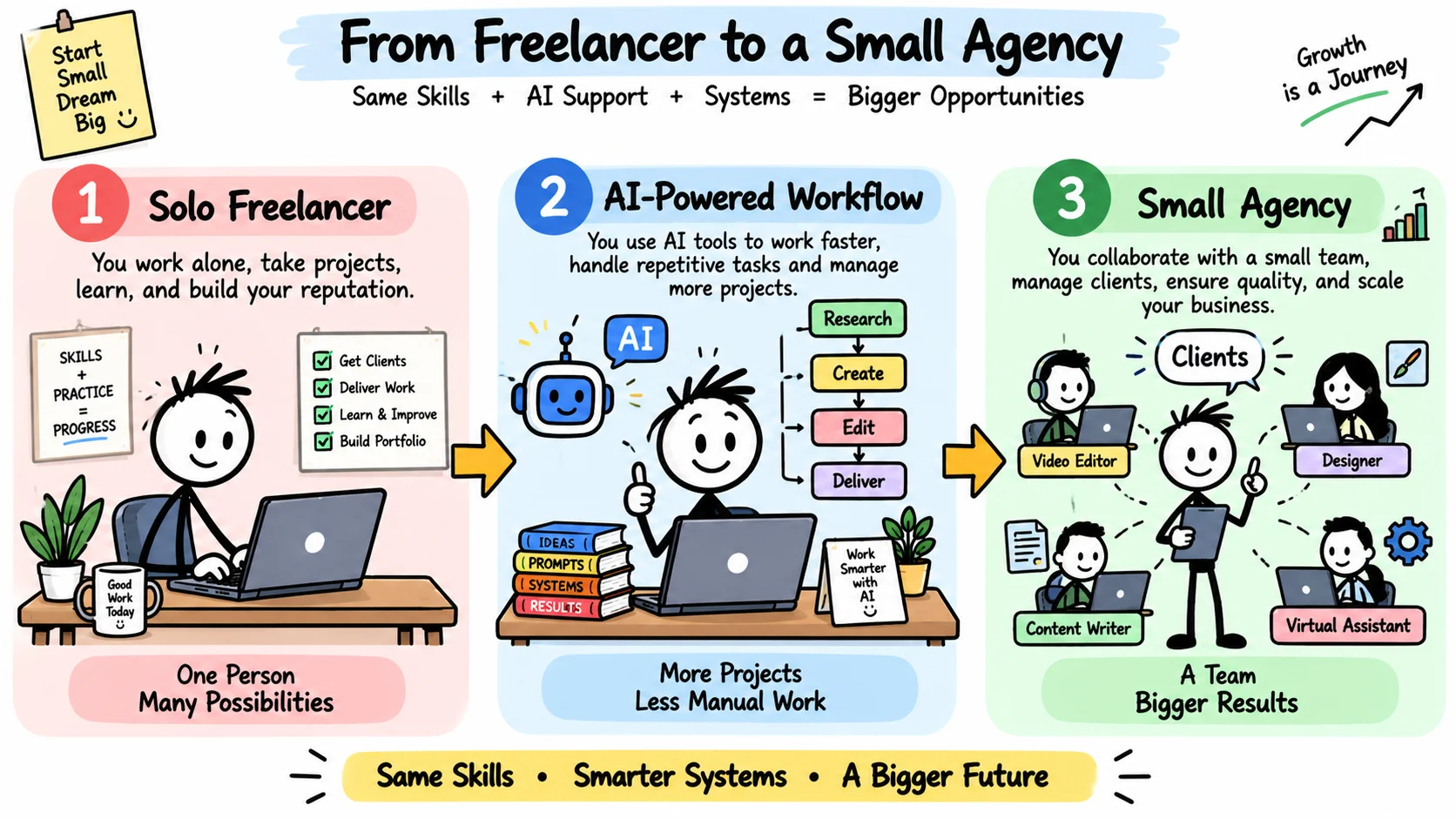
How a Freelancer Can Grow Into an Agency
You don’t need to start with a team.
Start with yourself.
Get one client.
Then another.
Once you understand the workflow, document the process.
If demand grows, you can potentially outsource specific production tasks to other freelancers while continuing to handle strategy, customer communication, and quality control yourself.
That’s how a solo freelancer can gradually turn a service into a small agency.
Beginner strategy
If you’re starting from scratch:
- Pick one skill.
- Pick one customer type.
- Create 5 strong sample projects.
- Build an AI-assisted workflow.
- Create one simple service package.
- Start contacting potential customers.
- Improve the service based on real feedback.
Don’t wait until everything is perfect.
Your first goal is not to build a huge agency.
Your first goal is to prove that someone is willing to pay for the problem you can solve.
2. AI-Powered Digital Products
The second business model is selling digital products.
Digital products can include:
- Ebooks
- Templates
- Spreadsheets
- Notion templates
- Canva templates
- Checklists
- Planners
- Presentation templates
- Educational resources
- Prompt packs
- Printable resources
- Business documents
The attractive part is that you don’t have to manufacture and physically ship every copy.
But there’s a common mistake beginners make.
They think:
“I’ll use AI to create a 200-page ebook and sell it.”
Technically, you can.
But creating a lot of content doesn’t automatically create a valuable product.
The better question is:
What problem am I solving?
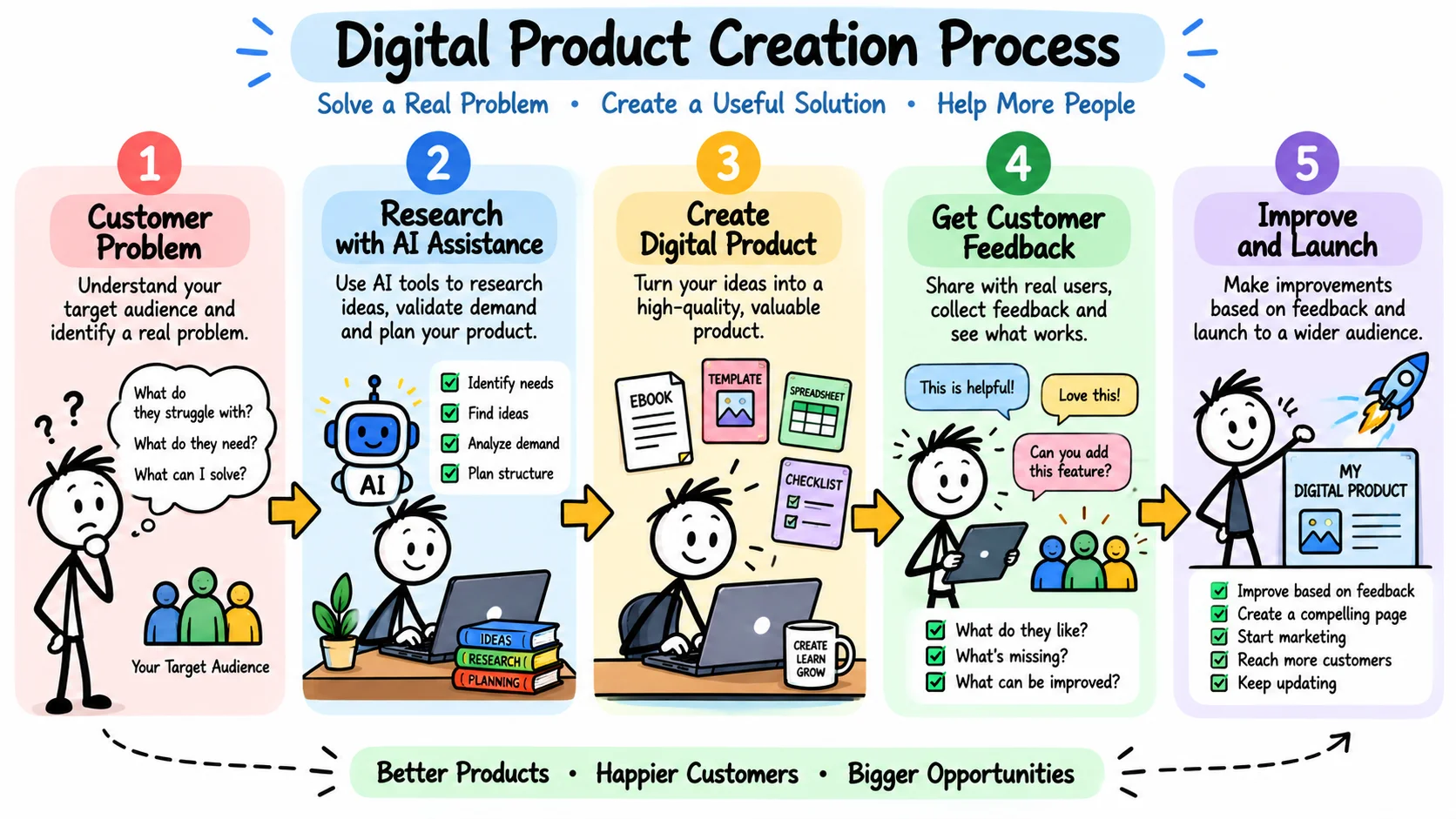
Use AI to Research the Problem
Imagine you want to create a study planner for students.
Before building it, you could use AI to help organize research around questions such as:
- What problems do students have with planning?
- What information should a study planner include?
- What does a useful weekly study system look like?
- What questions might customers ask?
- What sections might make the product easier to use?
Then you create a basic version.
Show it to a small group of potential users.
Ask:
- What is confusing?
- What’s missing?
- What’s unnecessary?
- What would make this more useful?
- Would you actually pay for this?
That feedback is extremely valuable.
AI can help you produce faster.
But customers tell you whether the product is actually useful.
A Simple Digital Product Example
Imagine your target audience is small YouTube creators.
You could create a:
YouTube Content Planning Template
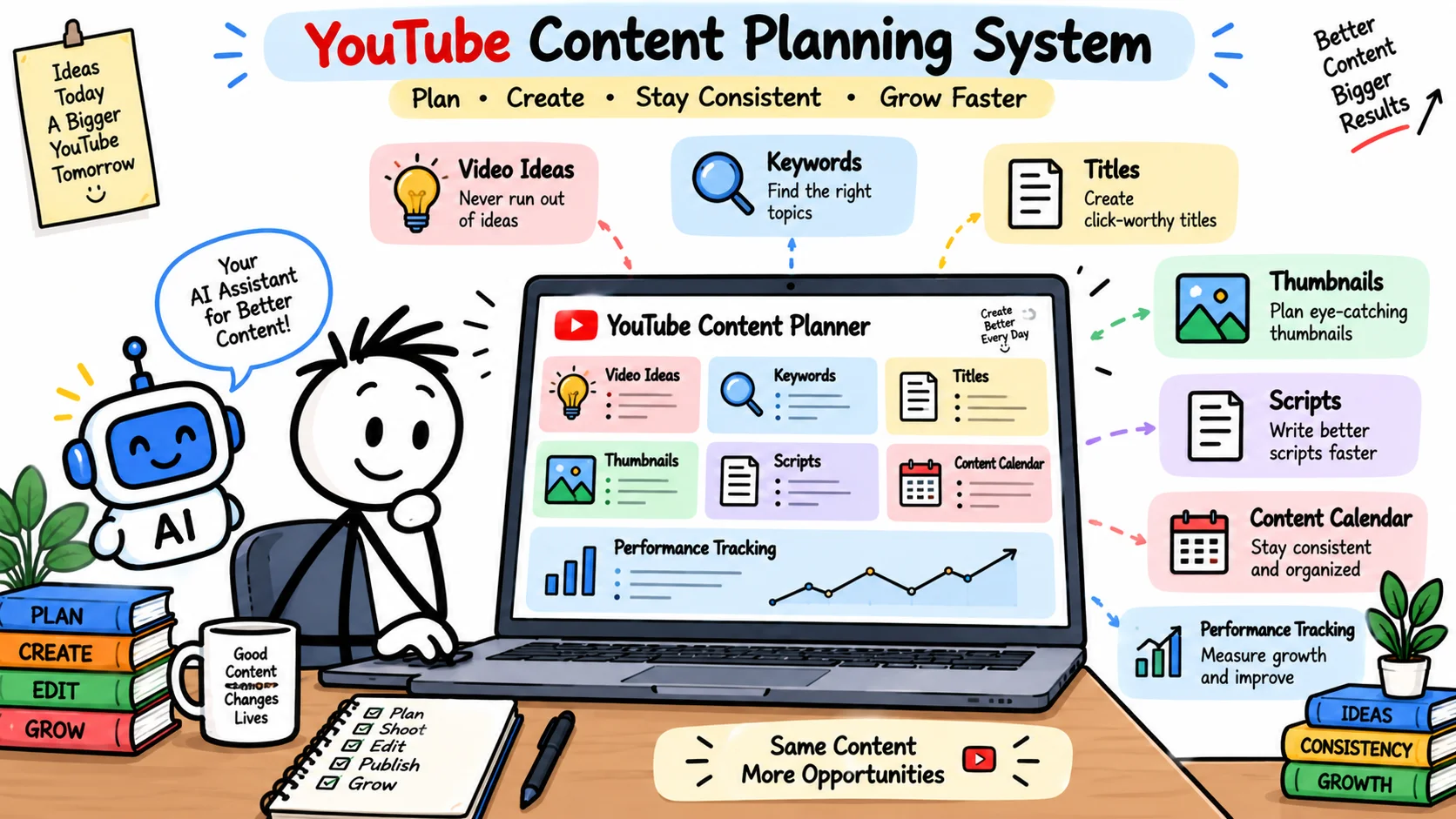
It might include:
- Video idea tracker
- Keyword research section
- Title ideas
- Thumbnail concepts
- Script outline
- Publishing checklist
- Content calendar
- Performance tracker
AI can help you create:
- Instructions
- Prompt libraries
- Content ideas
- FAQ drafts
- Marketing copy
- Email drafts
Now you’re not just selling a spreadsheet.
You’re selling a small content planning system.
That’s a much stronger product idea.
The Biggest Challenge With Digital Products
Creating the product is only half the job.
The other half is distribution.
You could create the best template in your niche, but if nobody knows it exists, you won’t get sales.
That’s why digital product businesses often work well with content.
For example:
YouTube → Free educational content → Audience → Digital product
You could publish:
- YouTube tutorials
- Blog posts
- Short videos
- Instagram posts
- Pinterest content
- Email newsletters
The content attracts people who have the problem.
The product provides a deeper solution.
That’s the basic business model.
3. AI-Powered Affiliate Marketing and Content Business
Affiliate marketing is another online business model that can be operated without a traditional office.
The basic concept is simple.
You recommend another company’s product or service.
If someone makes a qualifying purchase or completes another qualifying action through your referral, you may receive a commission according to the affiliate program’s terms.
But here’s what many beginners misunderstand:
The affiliate link isn’t the business.
The audience is the business asset.
Your job is to create content that helps people make better decisions.
How AI Can Help With Affiliate Marketing
Let’s say your niche is:
AI tools for YouTubers.
Now you need to research tools, understand their features, compare them, create tutorials, answer questions, and produce content regularly.
That can become a lot of work.
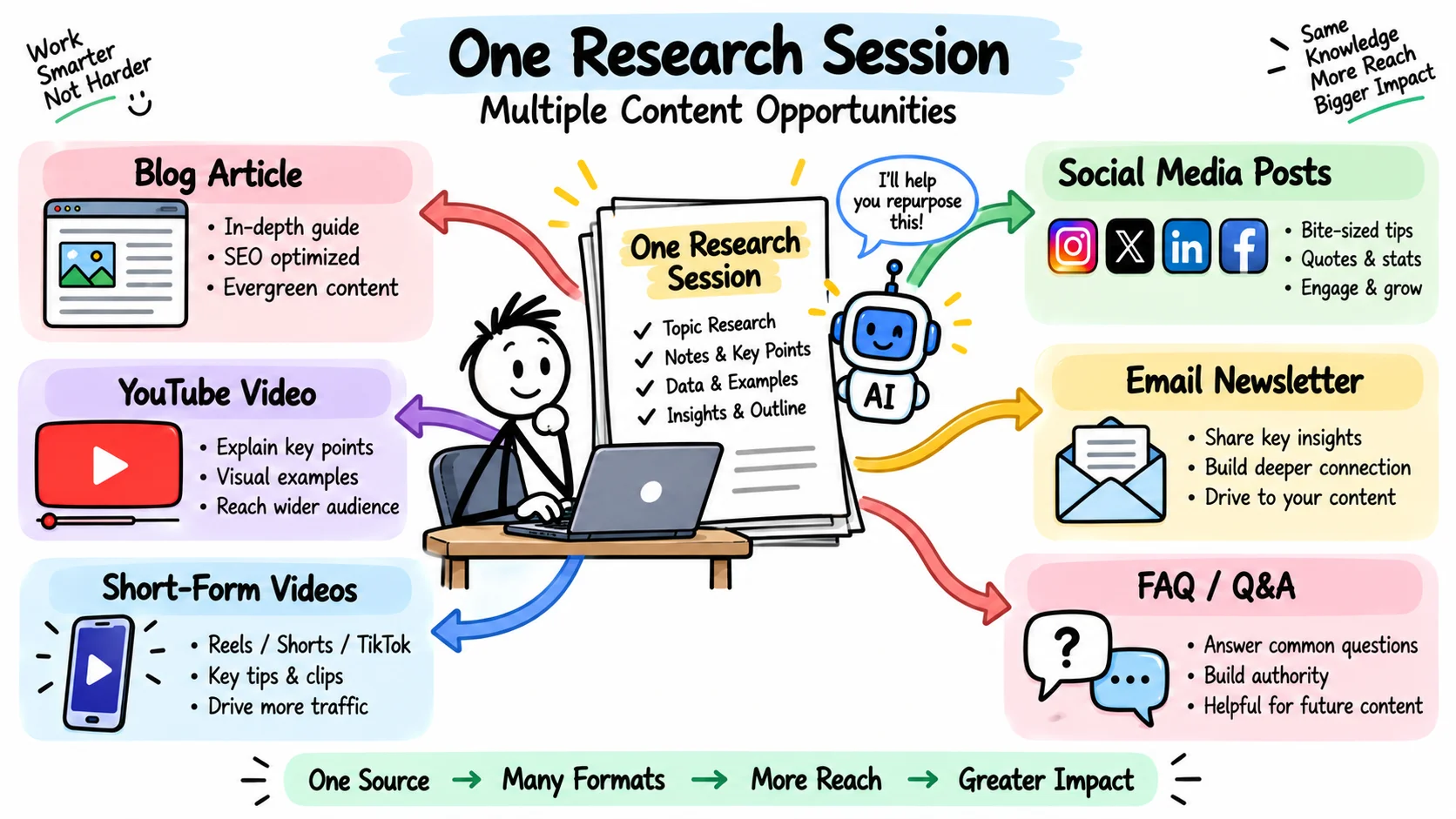
AI can help you turn one research session into multiple content formats.
For example:
You research one AI video tool.
Then you can create:
- A detailed blog post
- A YouTube video
- Several short videos
- Social media posts
- An email
- FAQs
- A comparison section
AI can help with the first drafts and repurposing.
But don’t blindly publish whatever the AI produces.
Prices change.
Features change.
Free plans change.
Usage limits change.
Affiliate terms change.
So important information should be checked against official sources before publication.
Think About Affiliate Marketing as a Content Business
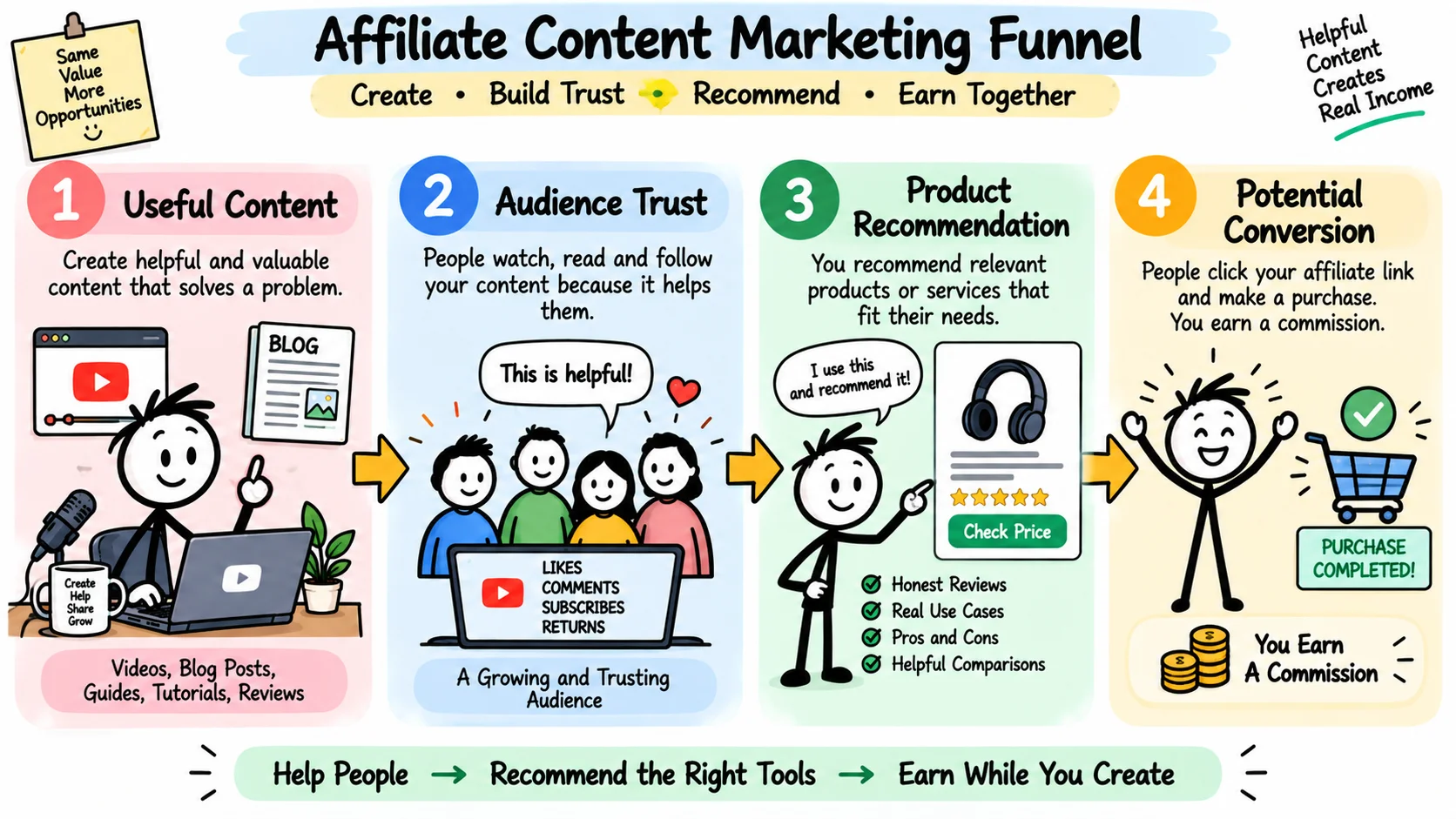
Instead of:
Affiliate link → Hope someone buys
Think:
Useful content → Trust → Relevant recommendation → Potential conversion
For example, you might create content such as:
- Best AI tools for YouTube thumbnails
- AI video editing tools for beginners
- AI tools for YouTube script research
- AI tools for content repurposing
- AI tools for small creators
If an appropriate affiliate program exists, you can recommend relevant tools according to that program’s rules.
But don’t recommend a product simply because it pays a higher commission.
If the product isn’t genuinely useful for your audience, you’re risking the most valuable thing you have:
Trust.
4. AI-Powered Print-on-Demand Business
Now let’s talk about print-on-demand, or POD.
This model can be interesting if you enjoy:
- Design
- Illustration
- Fashion
- Typography
- Niche communities
- Ecommerce
The basic idea is simple.
You create a design.
A customer orders a product.
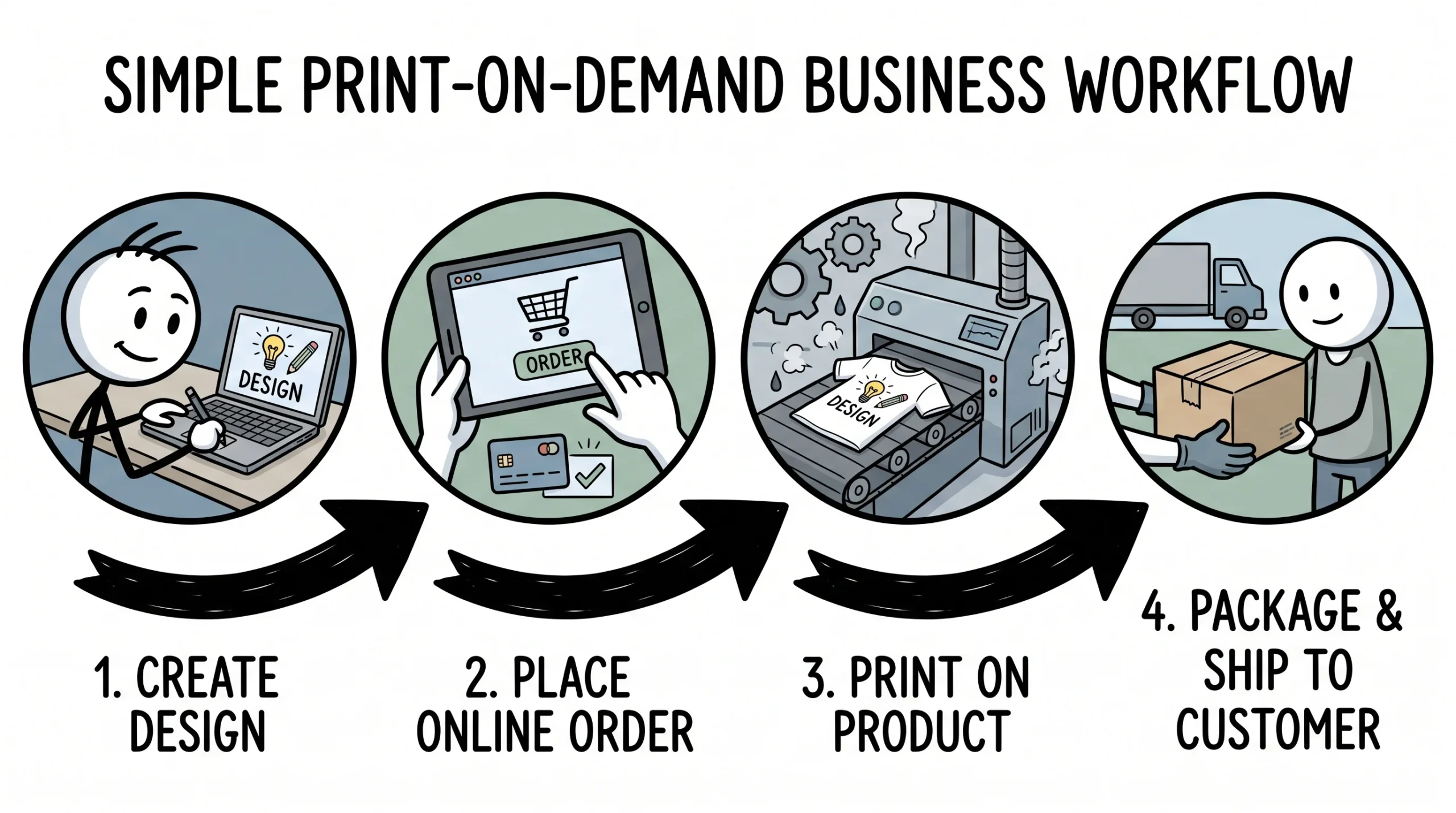
A print-on-demand provider prints and fulfills the order.
This can reduce the need to purchase and store large quantities of inventory upfront.
But don’t confuse that with “completely free.”
You may still have costs related to:
- Product production
- Printing
- Shipping
- Platform fees
- Payment processing
- Samples
- Advertising
- Design tools
So calculate your margins carefully.
How AI Can Help With Print-on-Demand
AI can be useful during the creative and marketing process.
For example, you can use it to brainstorm:
- Niche ideas
- Customer personas
- Design concepts
- Slogan variations
- Product descriptions
- Ad copy
- Social media ideas
Suppose you choose a niche such as pet owners.
Instead of creating generic “cute dog” designs, you might research a narrower audience.
For example:
Golden Retriever owners who love hiking.
Now your designs can speak to a more specific community.
AI can help you brainstorm dozens of creative directions.
But don’t upload hundreds of random designs just because AI makes it easy.
A better process is:
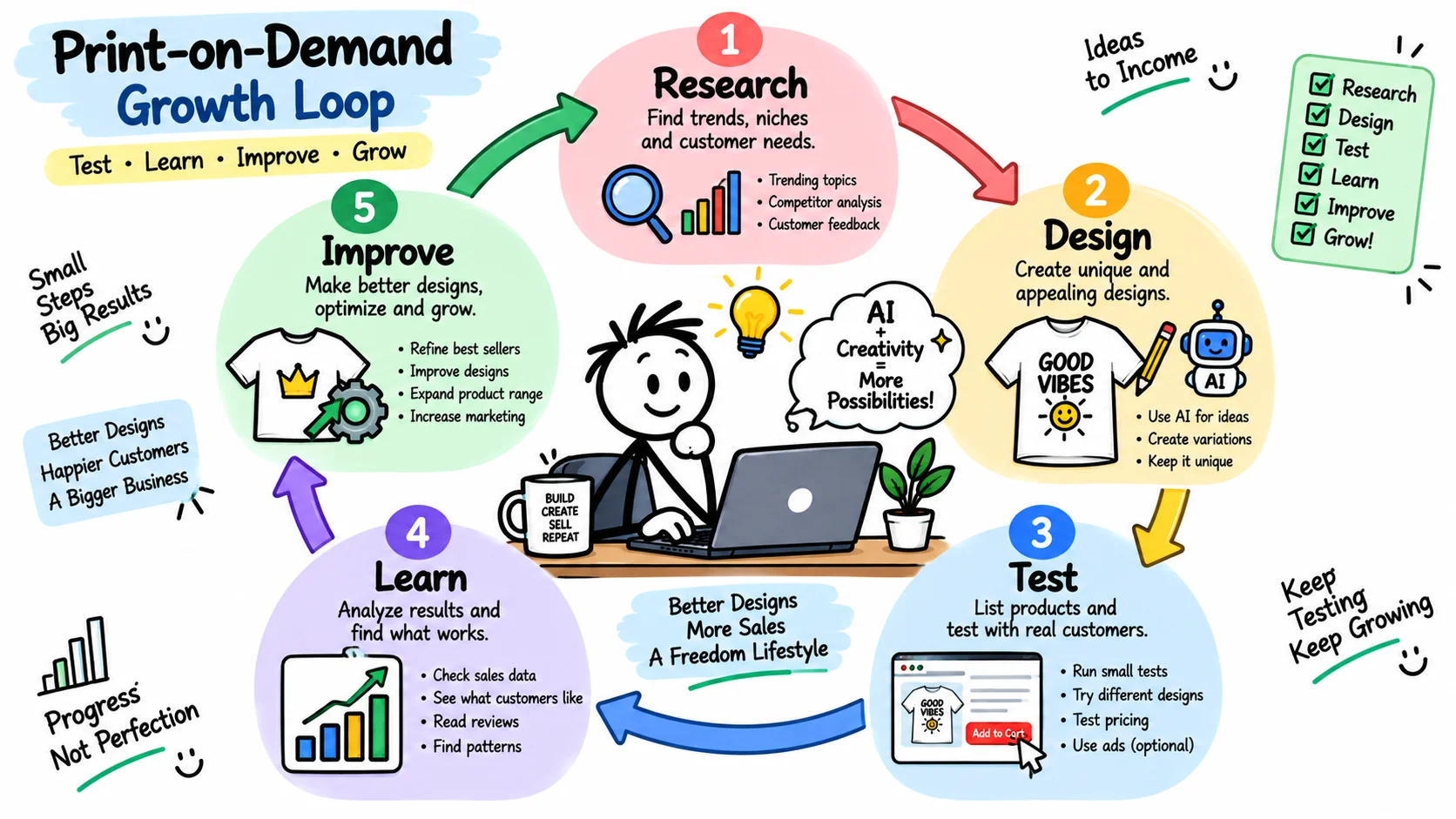
Research → Design → Test → Learn → Improve
Start with a small collection.
Look at what gets attention.
Then create more around the concepts that show genuine market interest.
Be Careful With Copyright and Trademarks
This is one area where beginners can get into trouble.
Just because an AI image generator can create something that looks like a famous character or brand doesn’t mean you automatically have the right to sell it.
Be careful with:
- Movie characters
- Company logos
- Sports team branding
- Famous characters
- Copyrighted artwork
- Celebrity likenesses
- Trademarked phrases
Focus on original designs or properly licensed material.
Your goal is to build a business you can continue operating, not one that creates unnecessary legal problems.
5. AI Consulting and Business Automation Services
Now we get to a business model that has become particularly interesting in the AI era.
AI consulting and implementation.
A lot of small businesses know AI is becoming important.
But knowing that AI exists and knowing how to use it inside an actual business are two different things.
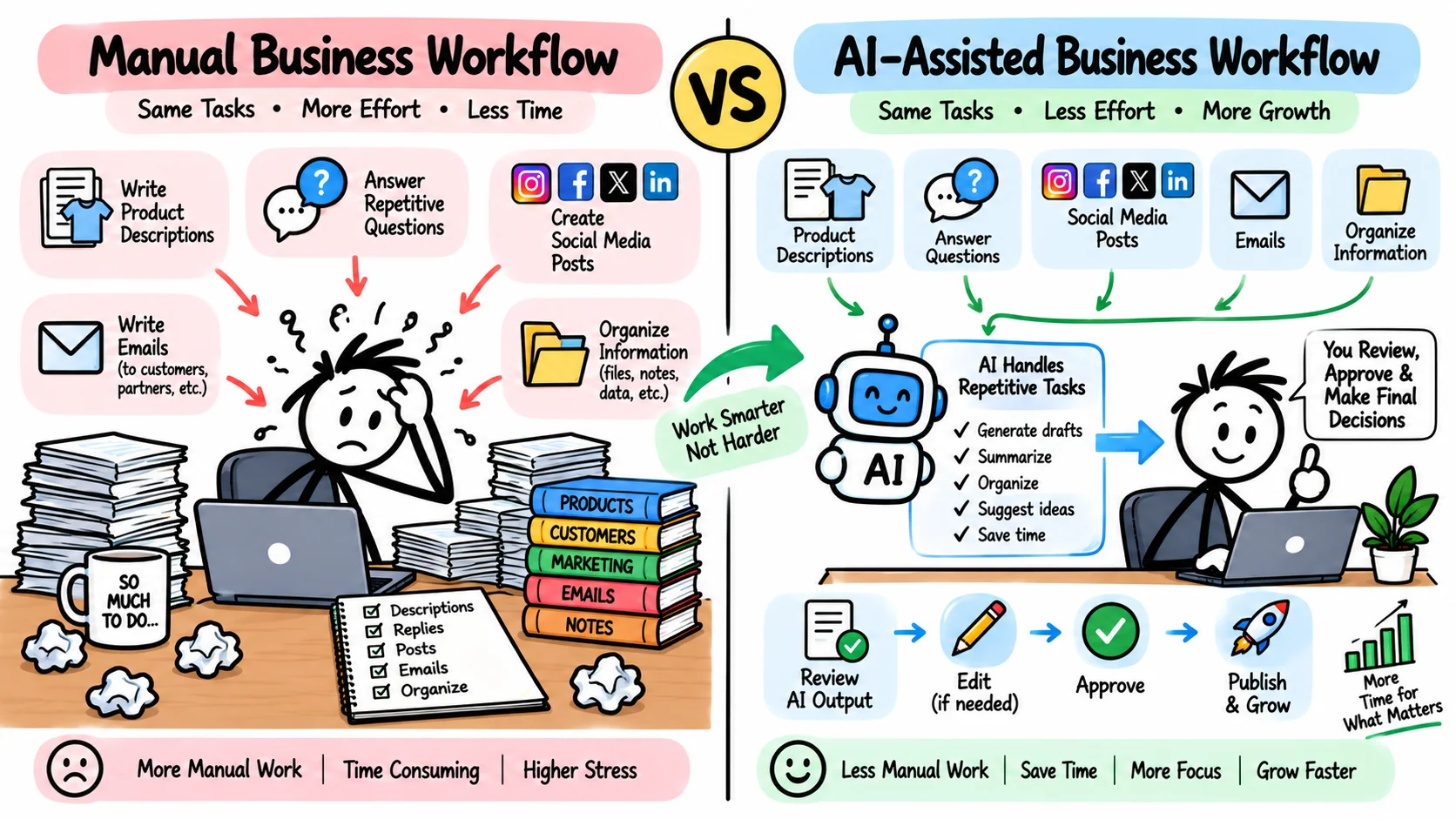
That gap can create a service opportunity.
Here’s a Simple Example
Imagine a small ecommerce business.
The owner spends hours every week doing things like:
- Writing product descriptions
- Answering common customer questions
- Creating social media posts
- Writing marketing emails
- Organizing product information
- Reviewing basic business data
You could help the business identify which repetitive tasks can be assisted by AI.
Your service might be:
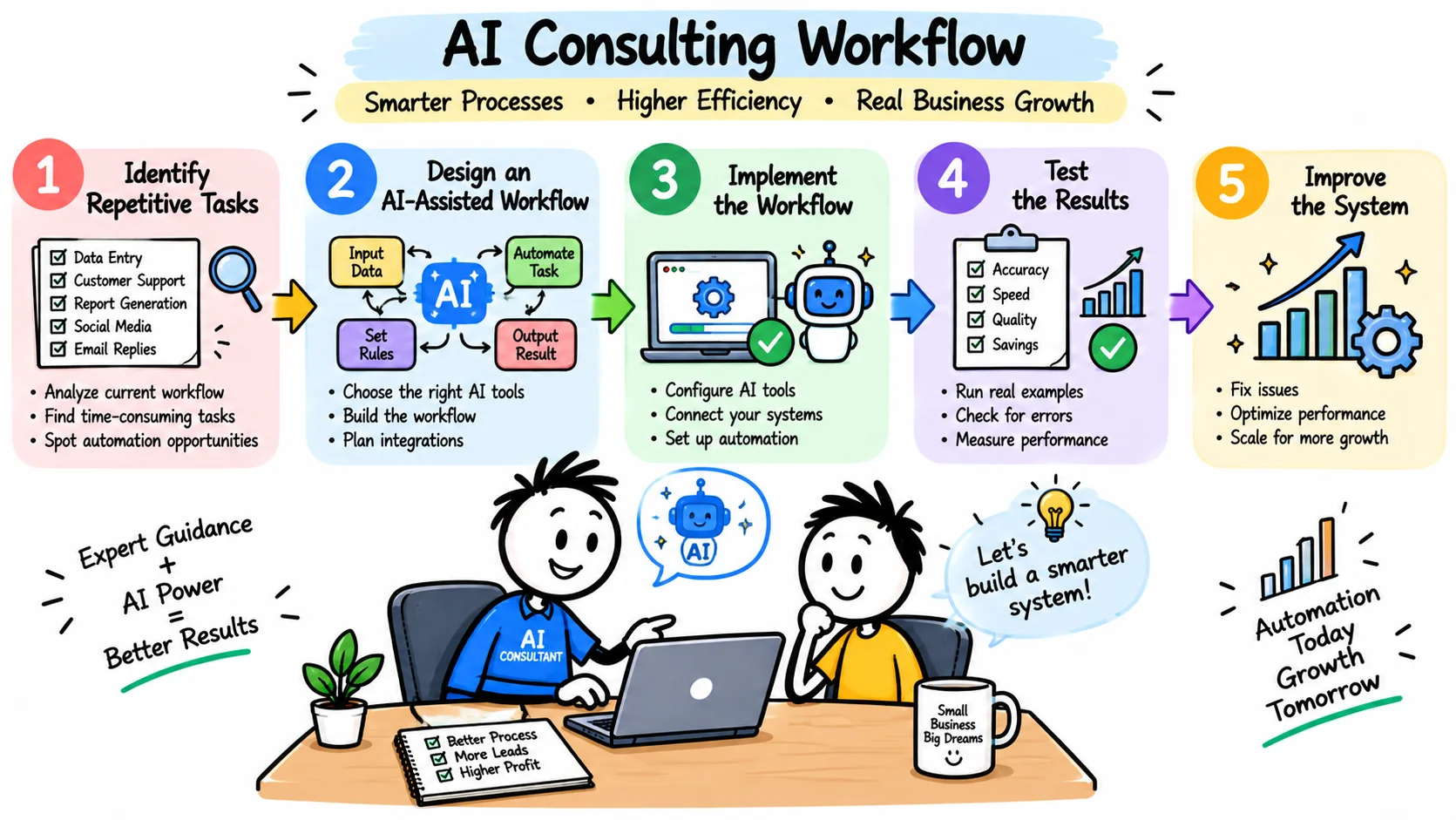
“I help small businesses identify repetitive tasks and build practical AI-assisted workflows.”
Notice what you’re not promising.
You’re not saying:
“I’ll add AI and automatically double your sales.”
You’re offering something much more realistic:
Identify → Design → Implement → Test → Improve
Real-World AI Tools Are Already Moving in This Direction
Shopify is one useful example.
Its AI tools include Shopify Magic and Sidekick, which are designed to help merchants with tasks such as content generation, store analysis, guidance, and other ecommerce workflows.
OpenAI’s 2026 research on small businesses also found that small businesses are using ChatGPT for a broad range of activities, including business planning, marketing, research, customer communication, and other operational work.
The important lesson isn’t that you need to sell a specific AI tool.
It’s that businesses increasingly need people who understand where AI actually fits into their workflow.
What Could You Offer as an AI Consultant?
Depending on your skills, you could specialize in areas such as:
AI Content Workflow
Help a business create repeatable systems for:
- Social media ideas
- Blog outlines
- Email drafts
- Content repurposing
Ecommerce Workflow
Help with:
- Product descriptions
- Product content
- Customer FAQs
- Marketing content
Customer Support Assistance
Help businesses organize frequently asked questions and build AI-assisted response workflows.
Content Repurposing
Turn one long piece of content into:
- Blog posts
- Short videos
- Social posts
- Newsletters
Internal Knowledge Systems
Help organize company information so employees can find answers more efficiently.
The complexity of the service depends on your technical skills.
If you’re a beginner, start with simple workflows rather than promising complicated automation that you don’t fully understand.
Which of These Businesses Is Right for You?
There isn’t one answer that works for everyone.
Instead of asking:
“Which business makes the most money?”
Start with:
“What can I realistically do well?”
Here’s a simple way to think about it:
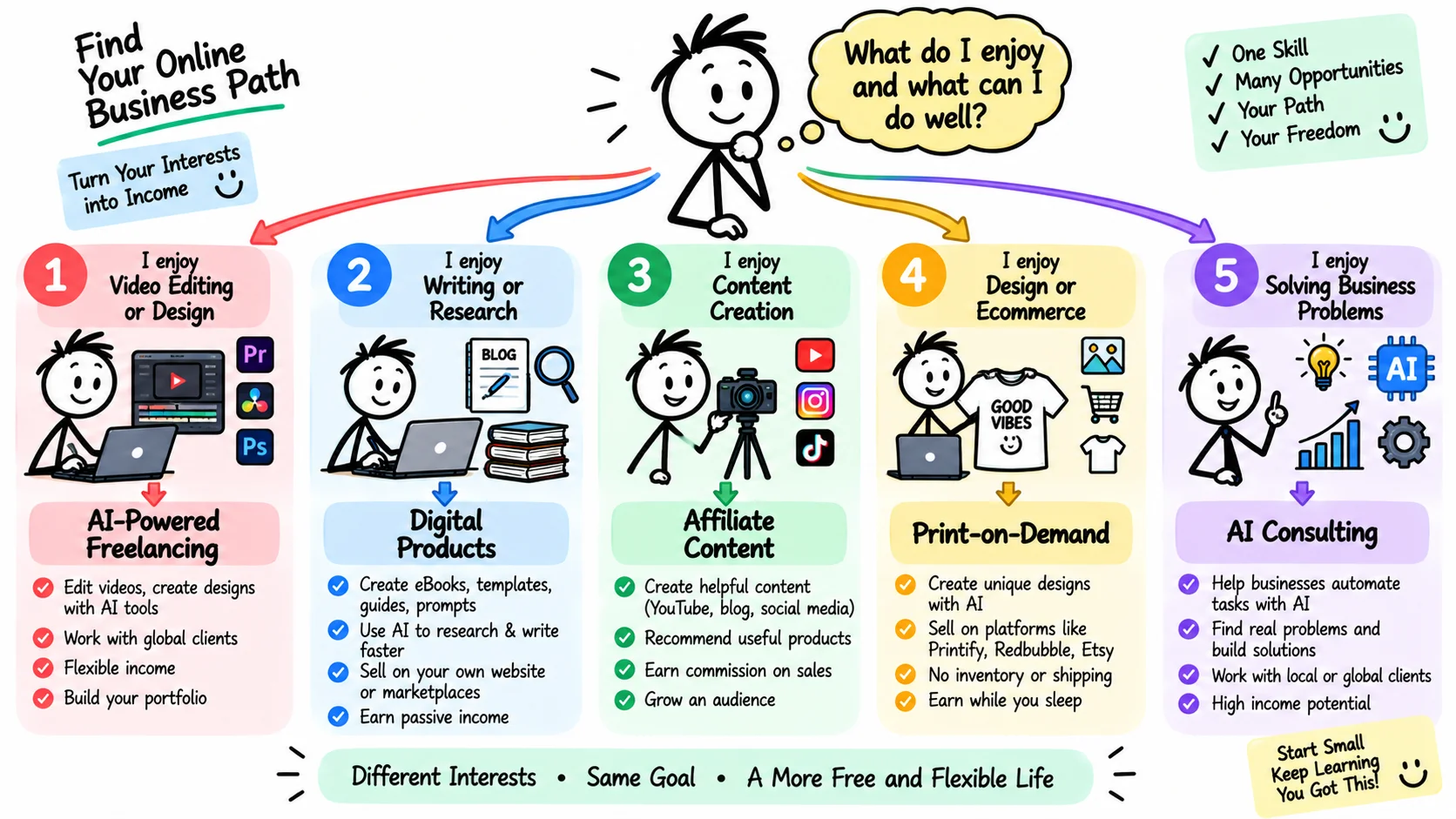
| If you enjoy… | Consider exploring… |
|---|---|
| Video editing/design | AI-powered freelancing |
| Writing/research | Digital products |
| Content creation | Affiliate content |
| Design/ecommerce | Print-on-demand |
| Solving business problems | AI consulting |
| Teaching | Digital products/consulting |
| Technology/automation | AI implementation |
If you’re a student, you may want something that can be tested around your existing schedule.
For example:
- Video editing
- Thumbnail design
- Writing
- Presentation design
- Research services
- Digital templates
- Content creation
These can be tested on a small scale before you commit more time or money.
But don’t assume that any of them will produce “daily income.”
Income can be unpredictable, especially when you’re just starting.
Can You Start These Businesses With No Money?
This is where it’s important to be realistic.
No office does not mean no expenses.
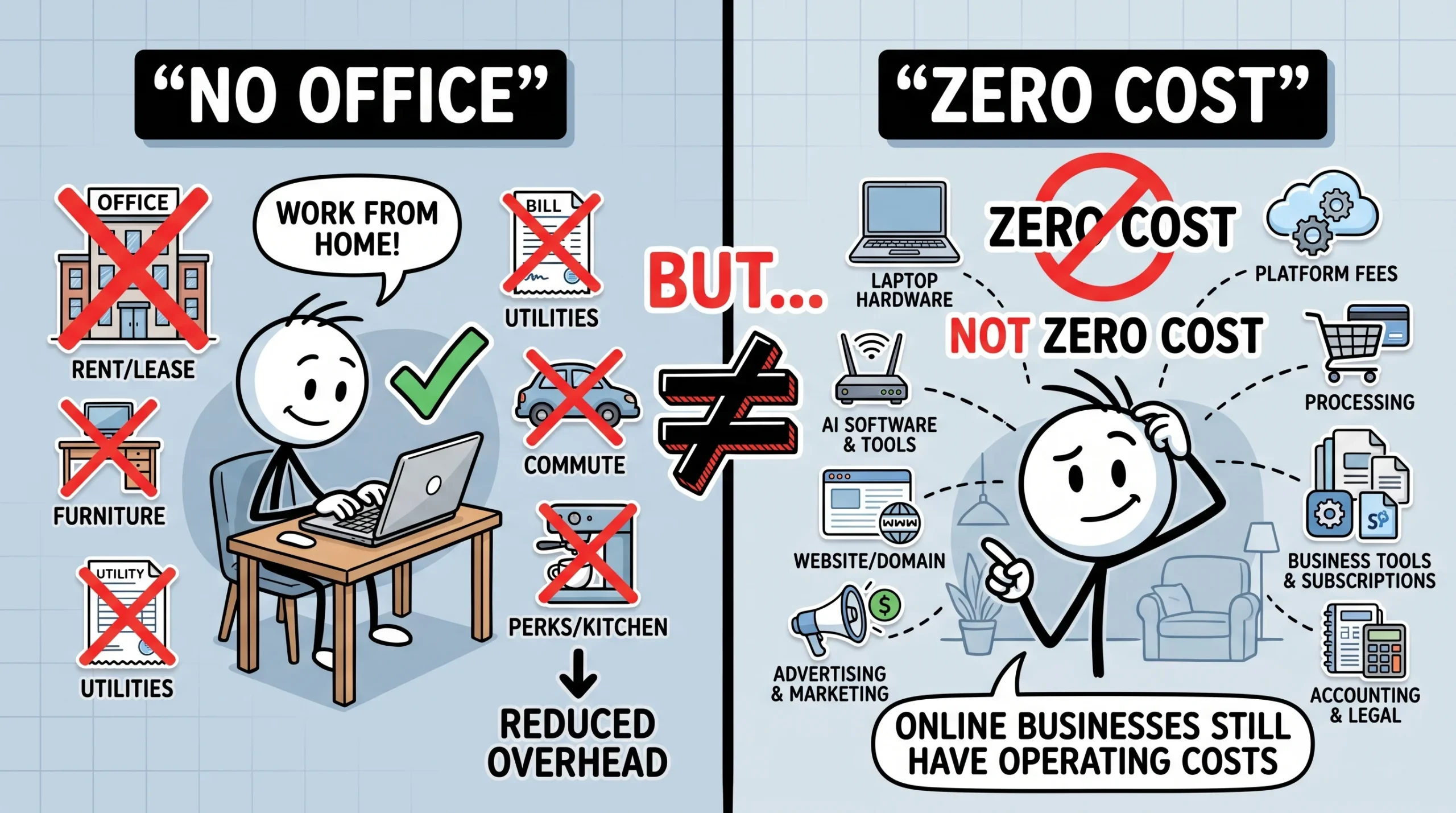
A service business may be relatively inexpensive to test if you already have a laptop and internet.
But you could still eventually spend money on:
- AI subscriptions
- Website hosting
- Domain
- Software
- Advertising
- Marketplace fees
- Payment processing
- Business registration
- Taxes
- Equipment
Digital products can avoid physical inventory, but they still require time and potentially software or platform costs.
Print-on-demand reduces inventory risk, but production and fulfillment still cost money.
Affiliate marketing may have low product costs because you’re not manufacturing the product, but building an audience takes time and resources.
So be careful with phrases like:
“Start a business with absolutely no money and make guaranteed income.”
The FTC warns consumers to be cautious about business opportunities that promise guaranteed income, large returns, or a “proven system.”
In 2024, the FTC also took action against an online business opportunity that it alleged had collected more than $12 million from consumers while promising substantial ecommerce profits.
The lesson is simple:
Research the business before spending money on the business.
The Biggest Mistake Beginners Make With AI
In my view, one of the biggest mistakes is:
Tool first, problem second.
People say:
“I have ChatGPT.”
“I have an image generator.”
“I have an automation tool.”
But a customer doesn’t care how many AI tools you have.
The customer cares about one thing:
Can you solve my problem?
That’s why this is a better business formula:
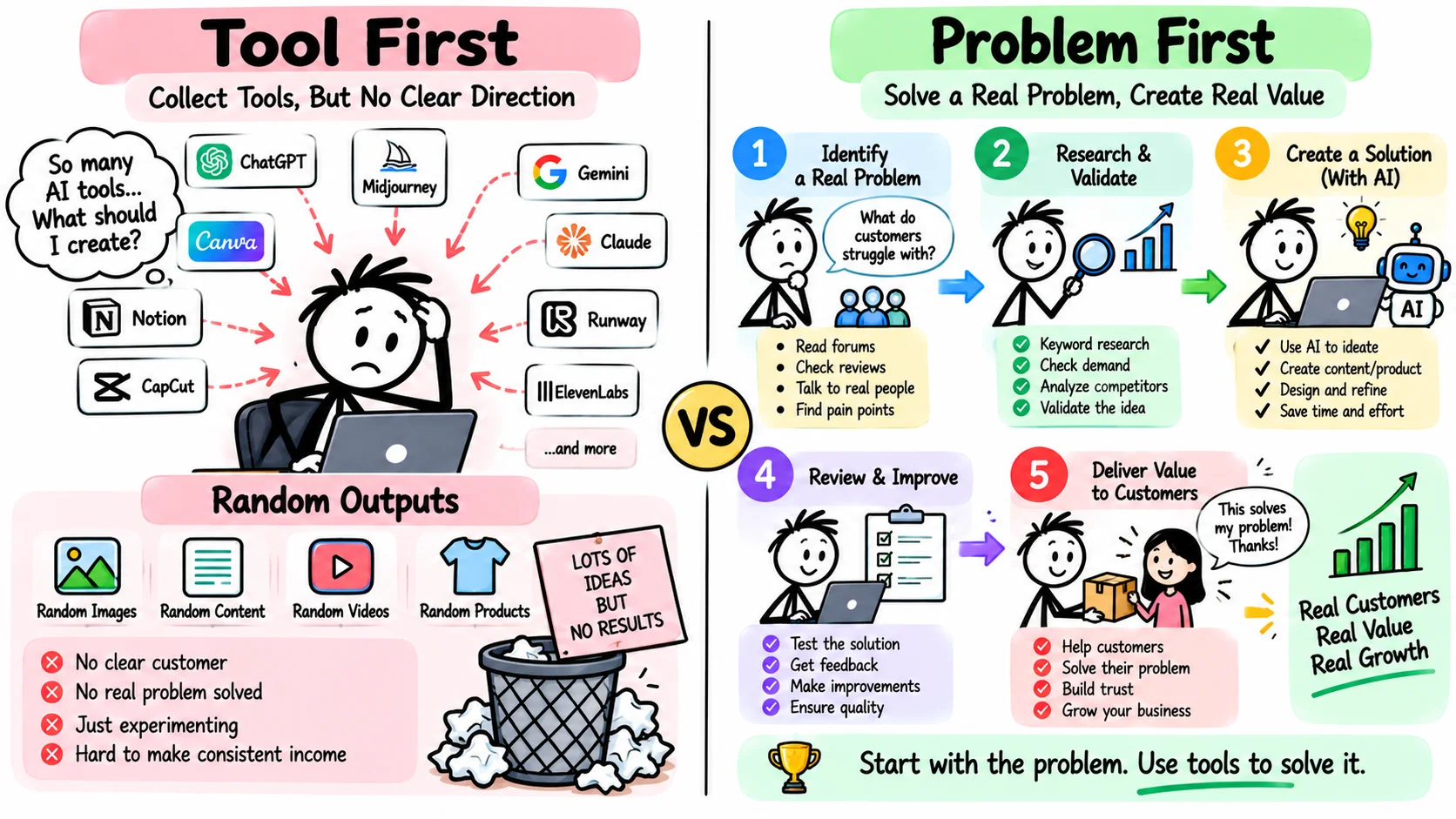
Weak approach
AI tool → Generate something → Try to sell it
Stronger approach
Customer problem → Research → Solution → AI assistance → Human review → Customer result
That small change in thinking can completely change the way you build an online business.
How to Use AI Properly in Your Business
Think about your work in two categories.
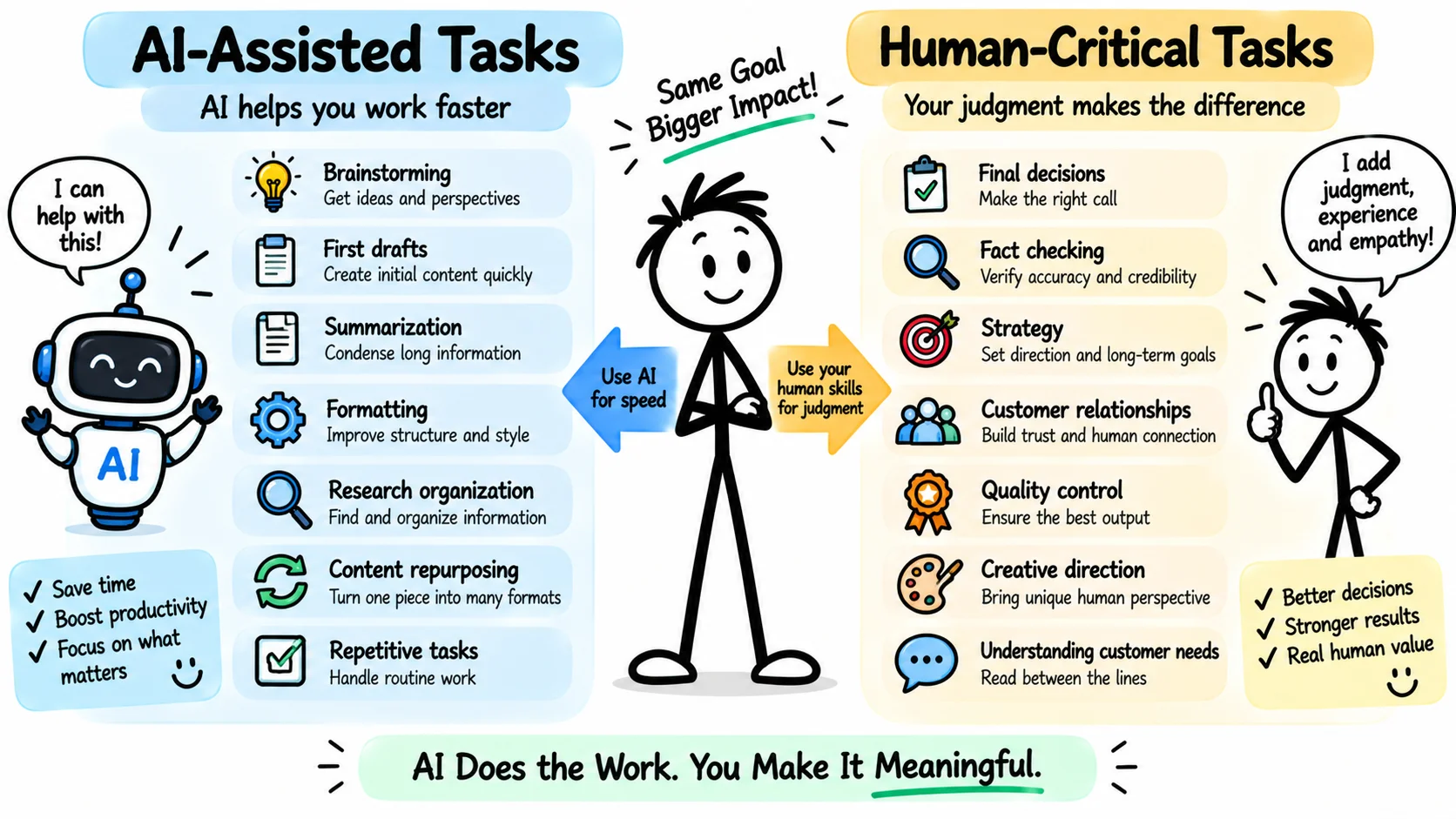
Tasks AI can assist with
AI can often help with things like:
- Brainstorming
- First drafts
- Summarization
- Formatting
- Research organization
- Content repurposing
- Creating variations
- Basic data organization
- Repetitive content tasks
Tasks that still need human judgment
You should remain responsible for:
- Final decisions
- Fact checking
- Strategy
- Customer relationships
- Quality control
- Creative direction
- Brand voice
- Legal decisions
- Understanding customer needs
This is important because AI can produce something quickly without necessarily producing something correct.
Shopify specifically warns that AI-generated content can contain errors and says merchants should review generated information before publishing.
The goal isn’t:
“Let AI do everything.”
The goal is:
“Let AI handle more of the repetitive work so I can spend more time on valuable work.”
A Simple 30-Day Plan for Beginners
If you’re starting from zero, don’t try to build a massive business in the first month.
Use the first 30 days to validate an idea.
Days 1-5: Choose Your Skill and Niche
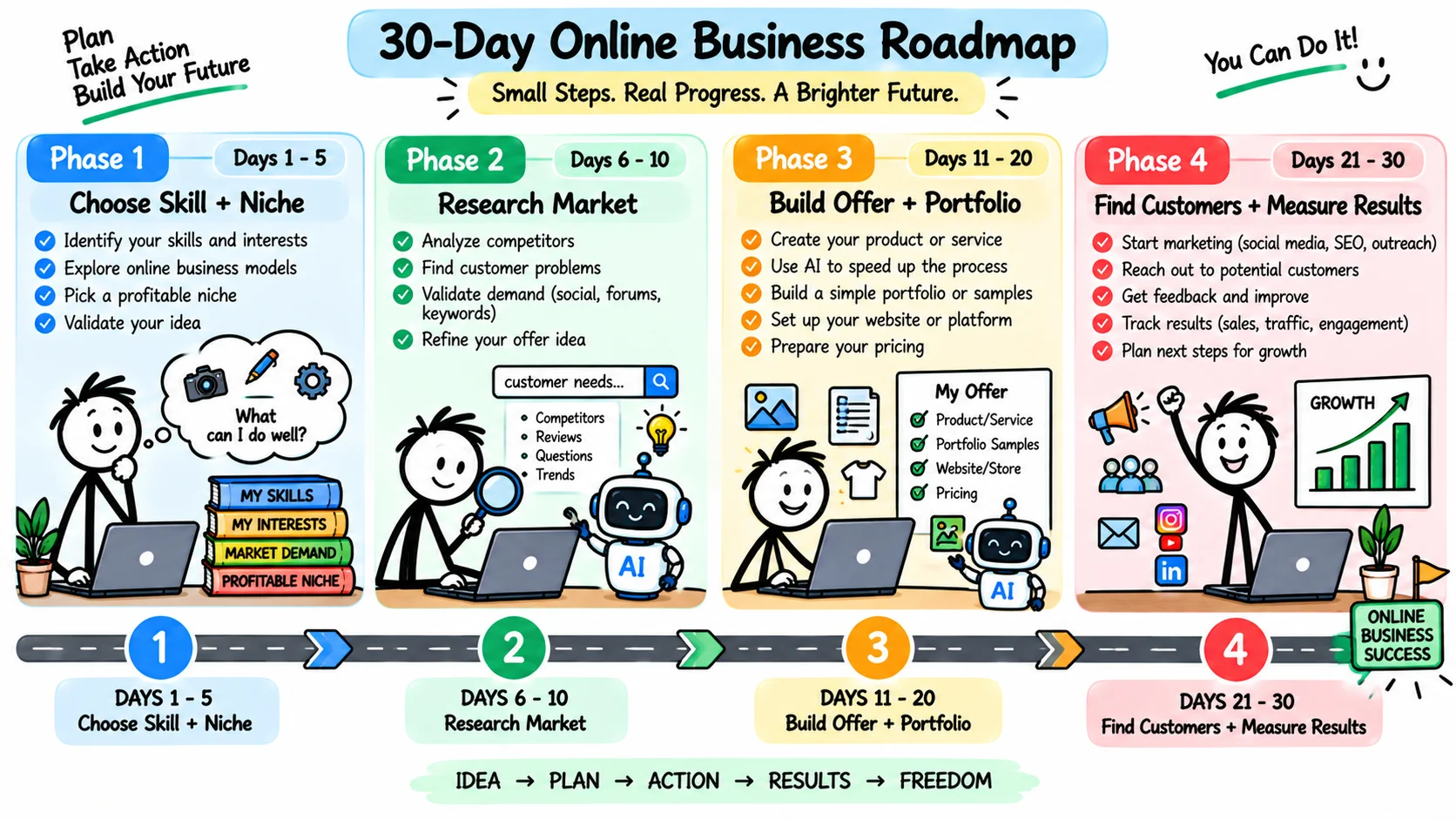
Ask yourself:
- What am I good at?
- What do I enjoy learning?
- What problem can I solve?
- Who might pay for that solution?
Choose one direction.
Days 6-10: Research the Market
Look at:
- Existing competitors
- Customer complaints
- Existing products
- Existing services
- Pricing
- Common questions
- Gaps in existing solutions
AI can help organize your research, but important facts should be checked against reliable original sources.
Days 11-15: Build One Offer
Don’t create 20 services.
Create one clear offer.
For example:
“I create 10 AI-assisted social media posts for small businesses.”
Or:
“I turn one YouTube video into five short-form videos.”
Or:
“I improve ecommerce product descriptions and create supporting marketing content.”
Keep it simple.
Days 16-20: Build Your Portfolio
No clients yet?
That’s okay.
Create sample projects.
Just label them honestly as:
Sample Project
Don’t pretend sample work is client work.
A small but honest portfolio is much better than fake experience.
Days 21-25: Find Potential Customers
Depending on your business, you can explore:
- Freelance marketplaces
- Email outreach
- Social media
- Online communities
- Personal networks
Don’t spam people.
Understand their business first.
Then explain how your service could help.
Days 26-30: Measure What Happened
Track:
- Number of people contacted
- Responses
- Conversations
- Proposals
- Sales
- Revenue
- Expenses
- Time spent
- Customer feedback
This information is far more useful than simply asking whether an idea “feels good.”
Quick Comparison of the 5 Business Models
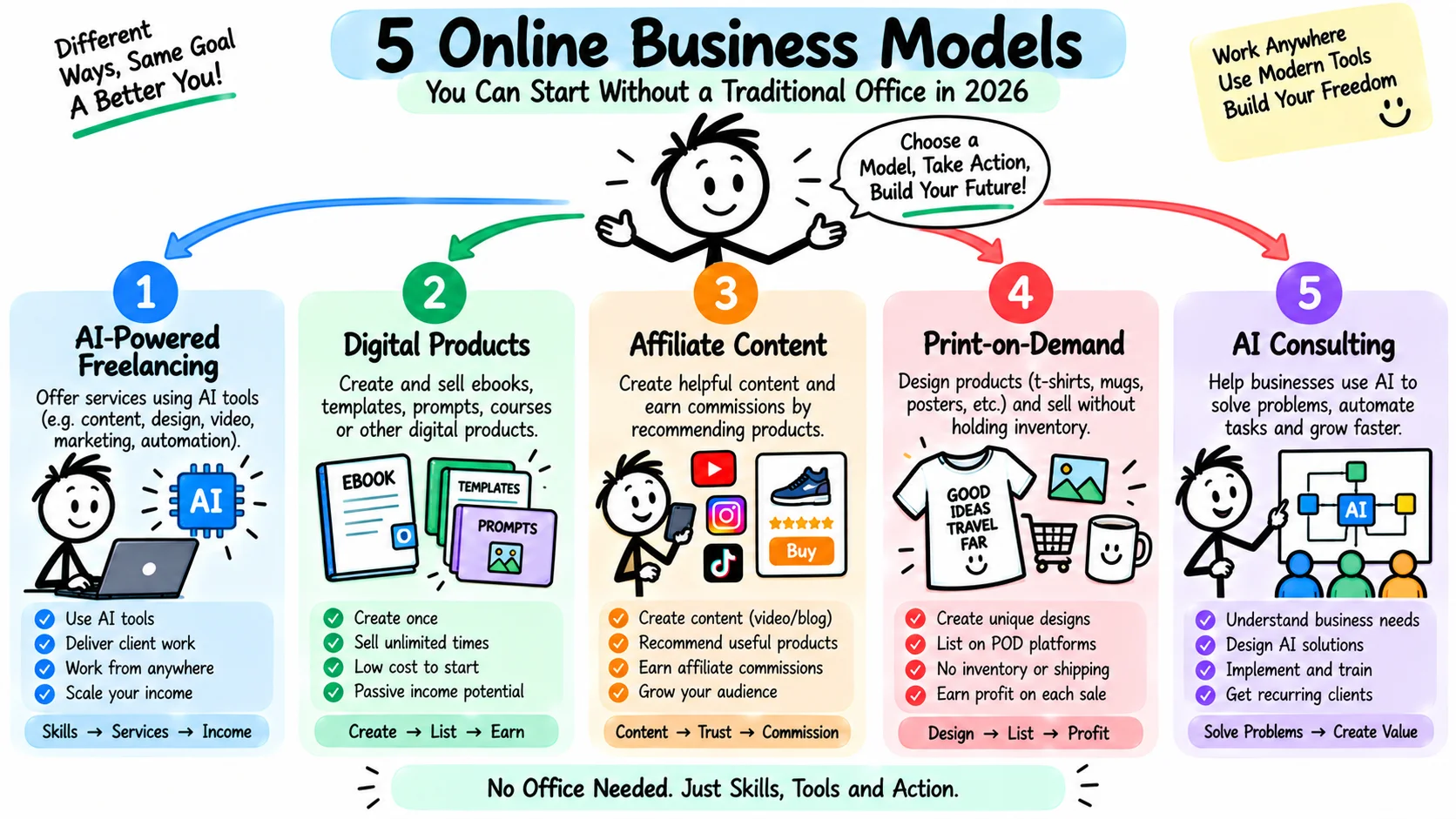
| Business | Main AI Use | Starting Requirement | Main Challenge |
|---|---|---|---|
| AI Freelancing | Production and repetitive tasks | Skill + laptop | Finding clients |
| Digital Products | Research, creation, marketing | Knowledge + product | Distribution |
| Affiliate Content | Research + content repurposing | Audience/content channel | Building trust |
| Print-on-Demand | Design ideas + marketing | Designs + platform | Competition and margins |
| AI Consulting | Workflow and automation | AI + business knowledge | Expertise and results |
None of these should be treated as guaranteed-income businesses.
Your results will depend on factors such as your skills, market demand, pricing, competition, execution, customer acquisition, and the quality of the solution you provide.
FAQs
What are the best online businesses you can start without an office?
Some of the best online businesses you can start without an office include AI-powered freelancing, selling digital products, affiliate marketing, print-on-demand, and AI consulting or automation services. These businesses can be operated remotely using a laptop, internet connection, and the right online tools.
Can I start an online business from home without investment?
Yes. Some online business ideas can be started with little or no upfront investment. Freelancing, content creation, affiliate marketing, and offering AI-powered services are examples. However, you may eventually need to spend money on tools, a website, advertising, software, or other business expenses as you grow.
What is the cheapest business to start from home?
Service-based businesses are usually among the cheapest businesses to start from home because you can sell your skills instead of buying inventory. Freelancing, content writing, graphic design, video editing, social media management, and AI-assisted services can all be started with relatively low costs.
What are the best AI business ideas for beginners in 2026?
Some practical AI business ideas for beginners include AI-assisted freelancing, creating digital products with AI, AI-powered content services, AI automation services, and helping small businesses use AI tools. The key is to solve a real customer problem rather than simply selling access to an AI tool.
Can students start an online business without an office?
Yes. Students can start several online businesses around their existing skills and available time. Freelancing, digital products, affiliate content, social media services, video editing, tutoring, and AI-assisted services are examples of business ideas that can be operated remotely.
Can I start an online business without money?
You can start some online businesses with very little money, but “no money” does not mean there are no costs at all. You can begin with free platforms and tools, validate your idea, and reinvest your first revenue into better software, hosting, marketing, or other business needs.
How can AI help me start an online business?
AI can help with tasks such as brainstorming, market research, writing drafts, creating content ideas, summarizing information, customer communication, data organization, and workflow automation. You should still review AI-generated work and use your own judgment, especially when accuracy, originality, or customer trust matters.
What online business can I start from home with low investment?
You can consider freelancing, affiliate marketing, digital products, print-on-demand, online consulting, and AI-powered services. Your initial cost will depend on the business model, tools you use, and whether you need a website, paid software, advertising, or inventory.
How can I make money online without selling physical products?
You can make money online by selling services, digital products, knowledge, or content. Examples include freelancing, consulting, online courses, templates, ebooks, affiliate marketing, video editing, design services, and AI-powered business services.
Is affiliate marketing still a good online business idea?
Affiliate marketing can still be a viable online business model, but it is not a guaranteed way to make money. Successful affiliate marketing generally requires useful content, relevant products, audience trust, and consistent traffic from sources such as search engines, YouTube, social media, or email.
Is print-on-demand a good business to start without an office?
Print-on-demand can be operated without maintaining your own inventory or physical office. When a customer places an order, a print-on-demand provider can produce and ship the product. Your main responsibilities include choosing a niche, creating or sourcing designs, marketing the products, and managing your store.
What is the best online business for a beginner?
There is no single online business that is right for everyone. A good starting point is usually a business that matches your existing skills, budget, available time, and interests. Beginners can start with a service they already know how to provide and gradually add AI tools to improve their productivity.
Can AI help me run an online business by myself?
Yes. AI can reduce the time needed for many repetitive tasks, which can make it easier for one person to manage different parts of an online business. However, AI does not replace the need for customer service, quality control, strategy, decision-making, and understanding your target audience.
What are some online business ideas that actually work?
Online businesses that solve clear customer problems can work across many industries. Examples include freelancing, consulting, digital products, affiliate content, ecommerce, print-on-demand, and specialized online services. Results depend on factors such as demand, execution, competition, pricing, marketing, and customer satisfaction.
How do I choose the right online business idea?
Start by asking three questions: What skills do I already have? What problem can I solve for other people? How much time and money can I invest? Then choose one business model, test it with a small offer, collect feedback, and improve it before investing heavily.
Can I start an online business without an office and still grow it into a full-time business?
Yes. Many online business models can start as a solo side project and grow as you gain customers and revenue. You can gradually create systems, automate repetitive tasks, outsource certain activities, and build a team when the business has enough demand to support it.
What are some daily income ideas from home?
Daily income can come from services where customers pay for completed work, such as freelancing, consulting, editing, design, tutoring, or other online services. However, income is not guaranteed every day, especially when you are starting. Building a reliable customer base usually takes time.
What are the best online business ideas without investment?
Some low-cost options include freelancing, affiliate marketing, content creation, digital services, consulting, and selling certain types of digital products. While you can begin with free tools, growing the business may eventually require investment in software, marketing, education, or infrastructure.
Can teenagers start AI-powered online businesses?
Teenagers can explore online business ideas such as content creation, design, video editing, digital products, or AI-assisted services, subject to applicable age requirements and platform rules. For minors, it is also important to involve a parent or guardian when contracts, payments, taxes, or business accounts require adult participation.
What is the biggest mistake beginners make when starting an online business?
One common mistake is spending too much time choosing tools and planning without testing whether people actually want the product or service. A better approach is to identify a real problem, create a simple offer, find potential customers, collect feedback, and improve the offer based on what you learn.
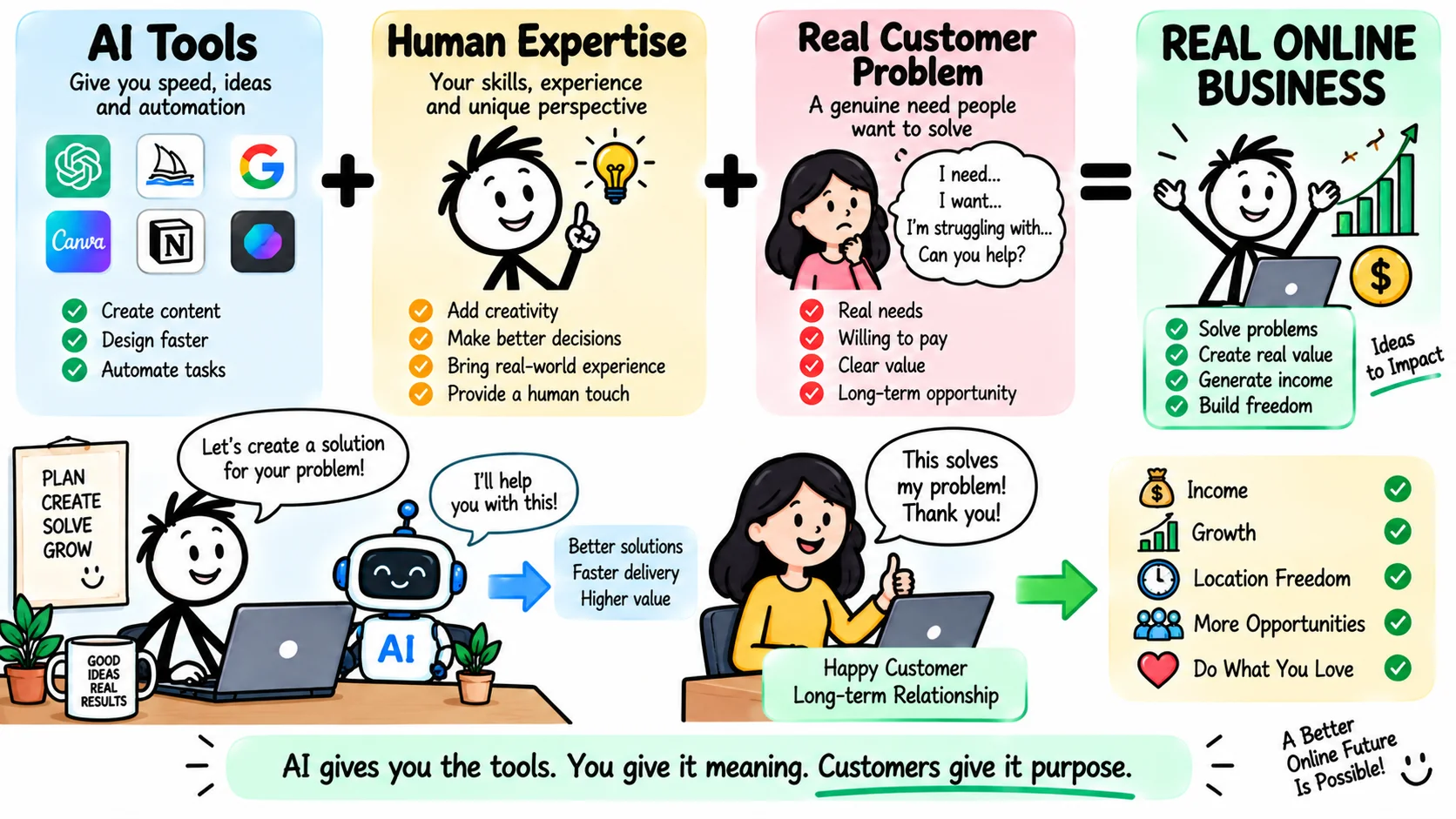
Final Thoughts: Start Small and Build Your Online Business
Starting an online business without an office is easier than it used to be. You do not necessarily need a big team, expensive office, or large investment to get started. With a laptop, internet connection, useful skills, and the right strategy, you can begin from home and grow over time.
The biggest opportunity in 2026 is the combination of AI + human skills. AI can help you research faster, create content, automate repetitive tasks, organize information, and save valuable time. But the real business value still comes from solving a genuine problem and giving people something useful.
If you are a beginner, do not try to start five businesses at once. Choose one online business idea that matches your skills and interests. It could be freelancing, digital products, affiliate marketing, print-on-demand, or AI consulting.
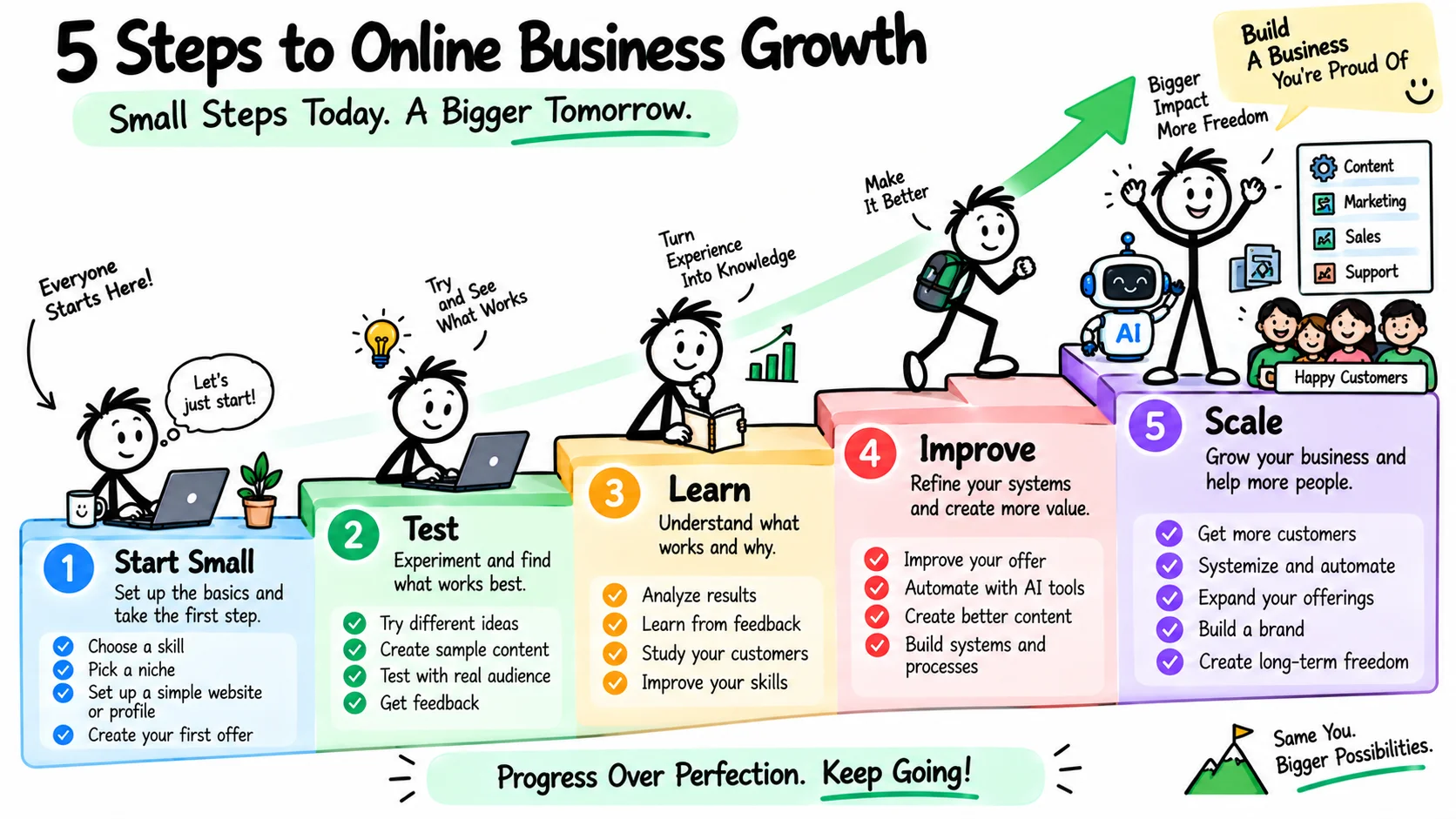
Start small. Find your first customer. Test your idea. Learn from feedback. Improve your offer. Then use AI and automation to make your workflow faster and more efficient.
And remember, no office does not mean no work, and no investment does not mean no effort. Building a business takes patience, consistency, learning, and the willingness to keep improving.
Whether you are looking for business ideas from home, online business ideas without investment, AI business ideas, business ideas for students, or low-investment business ideas, focus less on finding a “perfect” idea and more on finding a real problem you can solve.
Your first goal does not need to be building a huge company.
Your first goal can simply be getting your first customer.
Once you prove that people are willing to pay for what you offer, you can improve the system, attract more customers, and gradually turn your small online business into something much bigger.
Start small. Use AI wisely. Solve real problems. Keep learning. And build from there.

Sushil Kumar is a results-focused digital marketer specializing in SEO, content planning, and AI-powered workflows. His platform offers easy-to-use AI prompts for creating professional photos.