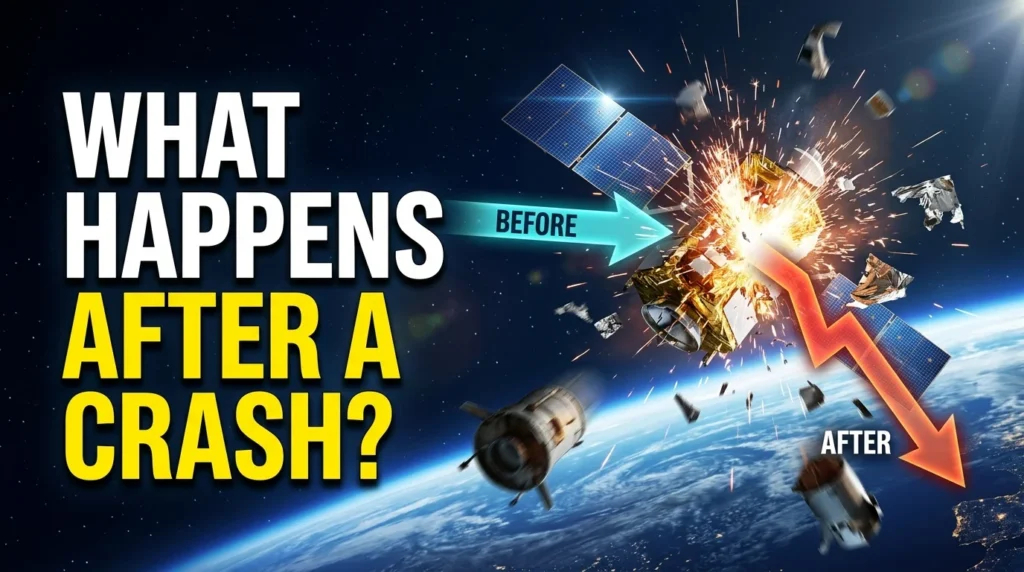
Imagine a satellite traveling through space when it suddenly collides with another object. Before the collision, it has a certain speed and direction. After the impact, it might move faster, slow down, change direction, or even break into smaller pieces.
So, what exactly causes this change?
Consider this question: A satellite was involved in two separate crashes. In both crashes, the satellite had the same mass. Engineers want to know how its speed and direction changed after each collision. Why would the crashes affect the satellite’s motion, and which crash caused a greater change in motion?
The answer comes down to a few important physics concepts: force, velocity, momentum, and impulse.
You don’t need to be a rocket scientist to understand them. Once you know how these concepts work together, you’ll be able to explain why collisions change an object’s motion and how engineers compare the effects of different impacts.
Let’s break it down step by step.
Why Do Collisions Change a Satellite’s Motion?
A satellite’s motion changes when a collision applies a force to it. That force can change its speed, its direction, or both.
According to Newton’s second law of motion, an object’s motion changes when a net force acts on it. During a collision, the interacting objects exert forces on each other, which can cause their velocities to change.
For example, imagine a satellite moving toward the right at a steady speed. It collides with a piece of space debris approaching from the opposite direction.
Depending on the debris’s mass, speed, direction, and the details of the impact, the satellite might:
- Slow down after the collision.
- Speed up if the impact pushes it in its original direction.
- Change direction if the collision pushes it sideways or backward.
- Begin rotating if the impact produces a turning effect.
- Sustain damage or break apart if the impact is severe enough.
The exact result depends on the collision itself.
A satellite doesn’t automatically stop moving when it crashes into something. Instead, the forces during the collision change its motion according to the laws of physics.
What Is Momentum, and Why Does It Matter?
Momentum is one of the most useful concepts for understanding collisions.
In simple terms, momentum describes how much motion an object has. It depends on two things: the object’s mass and its velocity.
The formula is:
Momentum = Mass × Velocity
Mathematically:
p = mv
Where:
- p represents momentum.
- m represents mass.
- v represents velocity, including both speed and direction.
Momentum is measured in kilogram-meters per second (kg·m/s).
Let’s look at a simple example.
Suppose a satellite has a mass of 500 kilograms and is moving at 10 meters per second.
Its momentum is:
p = 500 × 10
p = 5,000 kg·m/s
Now imagine the same satellite moving at 20 meters per second.
Its momentum becomes:
p = 500 × 20
p = 10,000 kg·m/s
The satellite’s mass hasn’t changed, but its momentum has doubled because its velocity has doubled.
This relationship is important when engineers study satellite collisions. If they know the satellite’s mass and its velocity before and after an impact, they can calculate how much its momentum changed.
OpenStax’s introductory physics textbook explains that momentum depends on both mass and velocity and that momentum is a vector quantity, meaning it has both magnitude and direction.
How Does a Collision Change Momentum?
When two objects collide, they exert forces on each other. Those forces can change the momentum of each object.
The change in momentum is calculated by subtracting the initial momentum from the final momentum:
Change in momentum = Final momentum − Initial momentum
In equation form:
Δp = p₍f₎ − p₍i₎
For an object whose mass stays constant, this can also be written as:
Δp = m(v₍f₎ − v₍i₎)
Here, the initial velocity is the velocity before the collision, and the final velocity is the velocity after the collision.
Let’s use the satellite example again.
Suppose the 500-kilogram satellite initially travels at 10 meters per second in a straight line.
After a collision, its velocity becomes 6 meters per second in the same direction.
Its initial momentum is:
p₍i₎ = 500 × 10 = 5,000 kg·m/s
Its final momentum is:
p₍f₎ = 500 × 6 = 3,000 kg·m/s
Therefore:
Δp = 3,000 − 5,000
Δp = −2,000 kg·m/s
The negative sign tells us that the momentum decreased along the chosen positive direction.
The magnitude of the change is 2,000 kg·m/s.
Notice that the satellite still moves forward. It simply moves more slowly than before.
This example shows why engineers compare the satellite’s motion before and after a collision rather than looking only at its final speed.
What Is Impulse, and How Is It Related to a Crash?
Another important concept is impulse.
Impulse measures the effect of a force acting over a period of time. During a collision, a force might act for only a fraction of a second, but that brief interaction can still produce a significant change in momentum.
The impulse-momentum theorem states:
Impulse = Change in momentum
Mathematically:
J = Δp
When using the average net force over the collision interval, the equation becomes:
J = F₍avg₎ × Δt
Where:
- J is impulse.
- F₍avg₎ is the average net force.
- Δt is the duration of the collision.
This equation explains why the strength of a force and the time it acts both matter.
For example, a relatively small force acting for a longer time can produce the same impulse as a larger force acting for a shorter time.
During a satellite collision, the impulse determines the change in the satellite’s momentum.
A larger impulse generally means a greater change in momentum. However, the direction of that impulse matters too. A sideways impulse can change the satellite’s direction even if its speed changes very little.
For a more detailed explanation, see OpenStax’s University Physics: Impulse and Collisions.
Which of the Two Satellite Crashes Caused a Greater Change in Motion?
Now let’s return to the main question.
A satellite experiences two separate crashes, and its mass is the same in both cases. Engineers want to determine which collision caused the greater change in motion.
The key is to compare the satellite’s change in momentum during each crash.
Because the satellite’s mass is the same in both cases, we can use:
Δp = mΔv
For the same mass, a greater magnitude of change in velocity corresponds to a greater magnitude of change in momentum.
However, velocity includes direction as well as speed. Therefore, engineers must compare the full velocity change, not just the difference between the two speed readings.
Example: Comparing Two Crashes
Suppose the satellite has a mass of 500 kilograms and initially moves to the right at 10 meters per second before each hypothetical crash.
Consider these two outcomes.
Crash 1: The satellite slows down
Before the collision, its velocity is +10 m/s.
After the collision, its velocity is +8 m/s.
Change in velocity:
Δv = 8 − 10 = −2 m/s
Change in momentum:
Δp = 500 × (−2)
Δp = −1,000 kg·m/s
The magnitude of the momentum change is 1,000 kg·m/s.
Crash 2: The satellite reverses direction
Before the collision, its velocity is +10 m/s.
After the collision, its velocity is −5 m/s.
Change in velocity:
Δv = −5 − 10 = −15 m/s
Change in momentum:
Δp = 500 × (−15)
Δp = −7,500 kg·m/s
The magnitude of the momentum change is 7,500 kg·m/s.
Comparing the Results
| Measurement | Crash 1 | Crash 2 |
|---|---|---|
| Satellite mass | 500 kg | 500 kg |
| Initial velocity | +10 m/s | +10 m/s |
| Final velocity | +8 m/s | −5 m/s |
| Change in velocity | −2 m/s | −15 m/s |
| Magnitude of momentum change | 1,000 kg·m/s | 7,500 kg·m/s |
In this example, Crash 2 caused the greater change in motion because the satellite experienced a much larger change in velocity and momentum.
The satellite slowed down in the first crash but reversed direction in the second. Reversing direction can produce a substantial momentum change because the initial and final velocity vectors point in opposite directions.
These numbers are hypothetical and illustrate the method. They are not measurements from an actual satellite collision.
What If the Question Includes a Diagram?
If your physics question shows two crashes using arrows, look carefully at the arrows representing the satellite’s velocity before and after each impact.
To compare the crashes:
- Identify the satellite’s initial velocity in each case.
- Identify its final velocity after each collision.
- Account for both the magnitude and direction of each velocity.
- Calculate or compare the magnitude of the velocity change.
- Since the mass is the same, the larger velocity change corresponds to the larger momentum change.
If the diagram instead shows the forces acting during each collision, compare the impulse produced by each force over its collision duration.
Without the actual velocities, arrows, or force information, it isn’t possible to identify which of the original two crashes caused the greater change with certainty.
Why Does the Satellite’s Mass Matter?
The question specifically states that the satellite has the same mass in both crashes. That detail makes the comparison easier.
Recall the momentum-change equation:
Δp = mΔv
If the mass stays constant, the magnitude of the momentum change is directly proportional to the magnitude of the velocity change.
This means engineers can compare the changes in velocity to determine which collision produced the larger momentum change.
For example, if the same satellite experiences a velocity change of 2 m/s in one collision and 6 m/s in another, the second collision produces three times the magnitude of the momentum change.
But there’s an important distinction: equal mass does not mean equal change in motion.
Two collisions can affect the same satellite differently because the objects involved may have different masses, velocities, directions, and collision characteristics.
The satellite’s mass alone does not determine the outcome.
Why Direction Matters as Much as Speed
One common mistake is to focus only on speed.
Speed tells us how fast an object is moving. Velocity tells us how fast it is moving and in which direction.
Momentum follows the direction of velocity.
Imagine a satellite traveling at 10 m/s to the right. After a collision, it travels at 10 m/s to the left.
Its speed is unchanged, but its velocity has changed dramatically.
If we define right as positive, the initial velocity is +10 m/s and the final velocity is −10 m/s.
The change in velocity is:
Δv = −10 − 10
Δv = −20 m/s
For a 500-kilogram satellite:
Δp = 500 × (−20)
Δp = −10,000 kg·m/s
The magnitude of the momentum change is 10,000 kg·m/s.
Even though the satellite has exactly the same speed before and after the collision, its momentum changes because its direction reverses.
This is why engineers need to examine both speed and direction when studying collisions in space.
How Engineers Study Satellite Collisions
Engineers and scientists use physics principles to understand how collisions affect spacecraft and other objects in orbit.
They may examine tracking measurements, onboard sensor readings, radar observations, or data about the objects involved.
The analysis generally involves several steps.
1. Measure the Satellite’s Motion
Engineers determine the satellite’s velocity before and after the collision. This includes its speed and direction.
2. Estimate the Momentum Change
Using the satellite’s mass and velocity measurements, they calculate its initial and final momentum.
3. Compare the Results
The difference between the initial and final momentum indicates how much the satellite’s motion changed.
4. Evaluate the Collision’s Effects
Engineers may also investigate whether the impact changed the satellite’s orbit, caused it to rotate, damaged its systems, or produced debris.
A collision can have consequences beyond a simple change in speed. Even a relatively small velocity change can alter a satellite’s orbit over time.
NASA’s educational resource on momentum and impulse explains these concepts through demonstrations and classroom activities, including examples relevant to spaceflight.
Common Mistakes to Avoid When Solving This Question
When answering a question about two satellite crashes, keep these points in mind.
- Don’t assume the heavier object always causes the greater change. The collision depends on the motion and properties of both interacting objects.
- Don’t compare only the final speeds. You need to consider the initial velocities too.
- Don’t ignore direction. A change from moving right to moving left can be large even when the speed stays the same.
- Don’t confuse force with impulse. Force describes an interaction, while impulse accounts for the force acting over time.
- Don’t assume equal mass means equal momentum change. Different collisions can produce different changes in velocity and momentum.
- Don’t choose a crash without enough information. If the question provides a diagram or data table, use those details to make the comparison.
These simple checks can help you avoid common errors and explain your answer more clearly.
Frequently Asked Questions (FAQs)
1. Why does a collision change a satellite’s motion?
A collision produces forces between the satellite and the object it hits. These forces can change the satellite’s velocity, causing it to speed up, slow down, or move in a different direction.
2. How can engineers determine which crash caused the greater change in motion?
They can compare the magnitude of the satellite’s momentum change in each crash. For a satellite with constant mass, they can calculate this using Δp = mΔv. The collision with the larger magnitude of momentum change caused the greater change in momentum.
3. Does a greater change in speed always mean a greater change in momentum?
For the same constant mass, a greater change in speed along a single, unchanged direction means a greater magnitude of momentum change. However, in two or three dimensions, direction must also be considered. A satellite can undergo a large momentum change even if its speed remains constant.
4. Can a collision change direction without changing speed?
Yes. A satellite can change direction while maintaining the same speed. Because velocity includes direction, this still represents a change in velocity and momentum.
5. What information is needed to compare two satellite crashes accurately?
You need the satellite’s mass and its initial and final velocity vectors for both collisions. Alternatively, suitable force and collision-duration data can help determine the impulse. Without enough information, you cannot identify the greater change with certainty.
Conclusion
A collision can change a satellite’s speed, direction, or both because the interacting objects exert forces on each other. The resulting change in motion can be analyzed using momentum and the impulse-momentum theorem.
The most important equation to remember is:
Δp = mΔv
When a satellite has the same mass in two different crashes, the collision that produces the greater magnitude of velocity change also produces the greater magnitude of momentum change.
In the hypothetical example above, Crash 2 caused the greater change because the satellite reversed direction, producing a much larger change in velocity.
However, if you’re answering a specific textbook question, check the supplied diagram or measurements before choosing Crash 1 or Crash 2. The information that the mass is the same, by itself, isn’t enough to determine which actual crash caused the greater change.
Ready to solve more physics questions? Start by identifying the known quantities, write down the relevant equation, and compare the initial and final states. With a little practice, concepts like momentum, impulse, and collisions become much easier to understand.
References and Further Reading
- NASA. STEMonstrations: Momentum and Impulse. An educational resource covering momentum, impulse, and their applications.
- OpenStax. University Physics Volume 1: Impulse and Collisions. A physics textbook section explaining the impulse-momentum theorem.
- OpenStax. Physics: Linear Momentum, Force, and Impulse. An introduction to momentum, forces, and changes in motion.

Sushil Kumar is a results-focused digital marketer specializing in SEO, content planning, and AI-powered workflows. His platform offers easy-to-use AI prompts for creating professional photos.