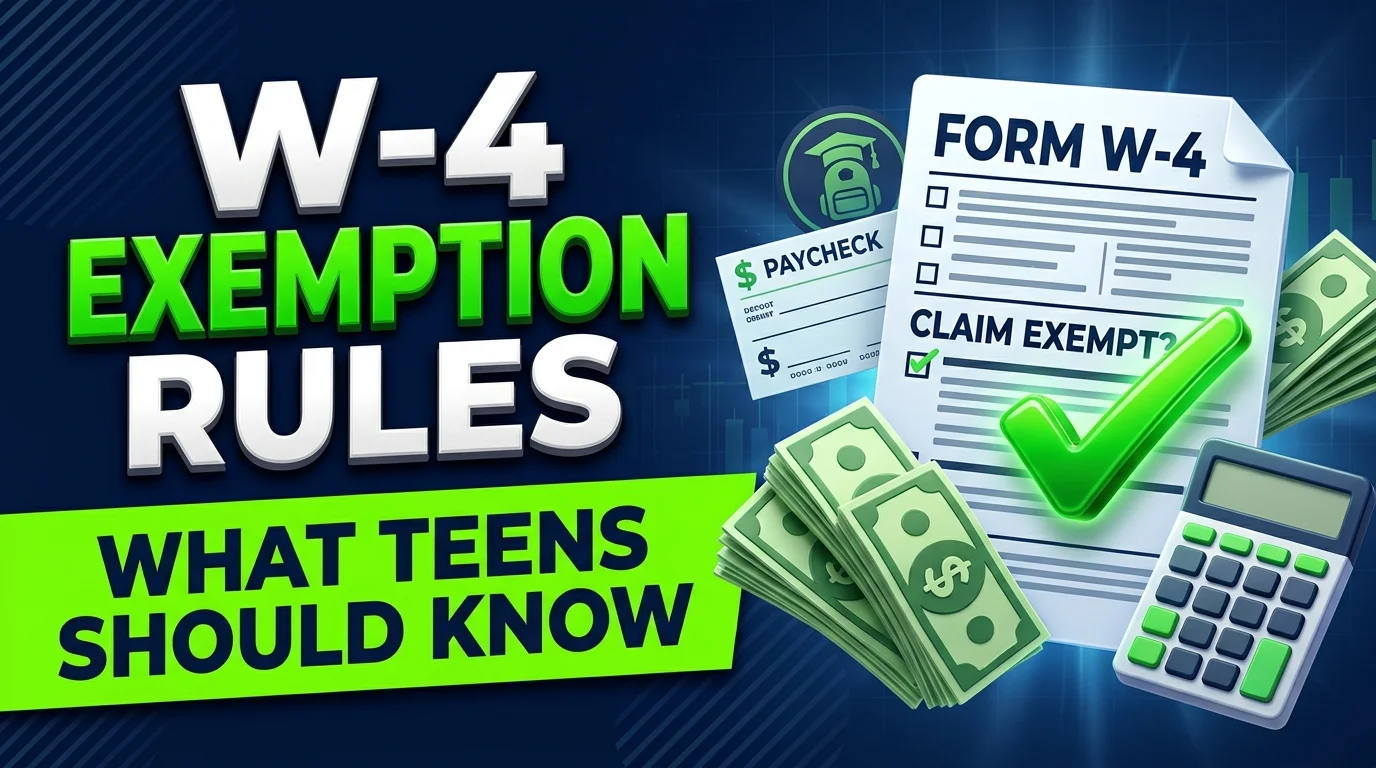
Starting a first job is exciting. Whether you’re working at a grocery store, restaurant, summer camp, or local business, getting your first paycheck feels like a big step toward financial independence. But when your employer hands you a Form W-4, you might notice a question about claiming exemption from federal income tax withholding.
That raises an important question: When Filling Out A W-4 Form, In What Situation Would A Teen Want To Claim Exemption From Federal Income Taxes Being Withheld From Their Paycheck? What Is The Benefit Of Doing So?
The short answer is that a teenager may claim an exemption if they had no federal income tax liability last year and reasonably expect to have none this year. The main benefit is that their employer generally won’t withhold federal income tax from their paychecks, leaving more money available to use right away.
However, claiming exemption isn’t the right choice for every teen. Your age alone doesn’t determine whether you qualify, and Social Security and Medicare taxes generally still apply.
Let’s break down the rules, explain how to fill out a W-4 for a summer job, and cover the mistakes young workers should avoid.
What Is a W-4 Form?
Form W-4, also called the Employee’s Withholding Certificate, tells your employer how to calculate federal income tax withholding from your paycheck.
When starting a new job, you’ll generally complete this form with your personal information, filing status, and any applicable withholding details.
If you qualify for exemption, you can follow the 2026 W-4 instructions to request that your employer stop withholding federal income tax.
When Can a Teen Claim Exemption From Federal Income Tax Withholding?
For 2026, you generally must meet both IRS requirements:
- You had no federal income tax liability for 2025.
- You expect to have no federal income tax liability for 2026.
Your age alone doesn’t determine eligibility. A 16-year-old or 17-year-old must meet these same requirements.
Example: A Teen With a Summer Job
Suppose a 16-year-old earns $15 an hour and works 20 hours a week for eight weeks during summer vacation.
Their estimated earnings would be:
- Hourly wage: $15
- Weekly hours: 20
- Work period: 8 weeks
- Total summer earnings: $2,400
If the teen has no other relevant income or tax circumstances and expects no federal income tax liability for 2026, they may qualify for exemption, provided they also had no federal income tax liability in 2025.
However, earning $2,400 alone doesn’t automatically establish eligibility. The teen must consider their complete tax situation.
What Is the Benefit of Claiming Exemption on a W-4?
The main benefit is more take-home pay.
For example, if $20 would otherwise be withheld for federal income tax during a pay period, a valid exemption generally means that amount stays in your paycheck.
This can help teenagers save for school supplies, a laptop, college, or other personal goals.
Keep in mind that Social Security and Medicare taxes generally still apply. Claiming exemption from federal income tax withholding doesn’t mean you’re exempt from every tax.
How to Fill Out a W-4 for a Student Summer Job
Follow these simple steps:
- Enter your name, address, and Social Security number.
- Select the appropriate filing status.
- Consider income from any other jobs.
- Check whether you meet both IRS exemption requirements.
- If eligible, follow the current Form W-4 instructions for claiming exemption.
- Review your first paycheck to make sure the withholding is correct.
If you don’t qualify, complete the W-4 using your actual circumstances rather than claiming exemption just to increase your paycheck.
Do 16-Year-Olds Pay Taxes If They Work?
Yes. Teenagers can owe federal income tax depending on their income and individual circumstances.
Being under 18, attending school, or being claimed as a dependent by a parent does not automatically eliminate federal income tax obligations.
A teen may also need to file a tax return to claim a refund of federal income tax withheld from their wages. Social Security and Medicare taxes generally still apply to ordinary employment.
FAQs
1. When can a taxpayer claim an exemption from withholding on a W-4?
A taxpayer can generally claim exemption from federal income tax withholding if they had no federal income tax liability in the previous year and expect to have none in the current year. For 2026, these conditions apply to the 2025 and 2026 tax years.
2. What should a 16-year-old claim on a W-4 in 2026?
A 16-year-old should complete Form W-4 based on their income and tax situation. They may claim exemption from federal income tax withholding if they meet both IRS requirements. Being under 18 does not automatically qualify them for exemption.
3. How do you fill out a W-4 for a student summer job?
To complete a W-4 for a summer job, enter your personal information, select the appropriate filing status, and follow the instructions for any applicable adjustments. If you qualify for exemption, follow the form’s specific exemption instructions.
4. Do 16-year-olds pay taxes if they work?
Yes, 16-year-olds can owe federal income tax depending on their income and circumstances. Social Security and Medicare taxes generally also apply to their wages, even when they qualify for exemption from federal income tax withholding.
5. Is a 17-year-old exempt from federal income tax withholding?
No, not automatically. A 17-year-old must generally have had no federal income tax liability in the previous year and expect none in the current year to claim exemption from withholding.
6. What does it mean to be exempt from federal tax withholding?
Being exempt from federal income tax withholding means your employer generally does not deduct federal income tax from your paycheck. It does not automatically exempt you from Social Security, Medicare, or other applicable taxes.
7. What is the benefit of claiming exemption on a W-4?
The main benefit is receiving more take-home pay because federal income tax is not withheld from your wages. This can help eligible teens save money for school, personal expenses, or future goals.
8. Can a teenager claim exempt on a W-4 if their parents claim them as a dependent?
Yes, potentially. Being claimed as a dependent does not automatically prevent a teenager from claiming exemption. The teen must independently meet the IRS requirements for federal income tax withholding exemption.
9. What happens if I claim exemption on my W-4 but end up owing taxes?
If you claim exemption but later owe federal income tax, you may need to pay the amount due when filing your tax return. Depending on your circumstances, an underpayment penalty may also apply.
10. Should I claim exempt on my W-4 for a part-time job?
You should claim exemption only if you meet both IRS requirements for the applicable tax year. If you expect to owe federal income tax, you generally should not claim exemption. Review the official IRS instructions before submitting your form.
Conclusion
A teenager should claim exemption on a W-4 only when they meet the IRS requirements for the tax year. The main advantage is receiving more take-home pay without unnecessary federal income tax withholding.
Before making your decision, review the official IRS Form W-4 and confirm that you qualify.
Disclaimer: This article provides general educational information, not individualized tax advice. Verify your eligibility using the current IRS guidance for 2026.
What Is the Best Way to Handle AI Hallucinations in a Business Report? A Practical Guide

Sushil Kumar is a results-focused digital marketer specializing in SEO, content planning, and AI-powered workflows. His platform offers easy-to-use AI prompts for creating professional photos.